
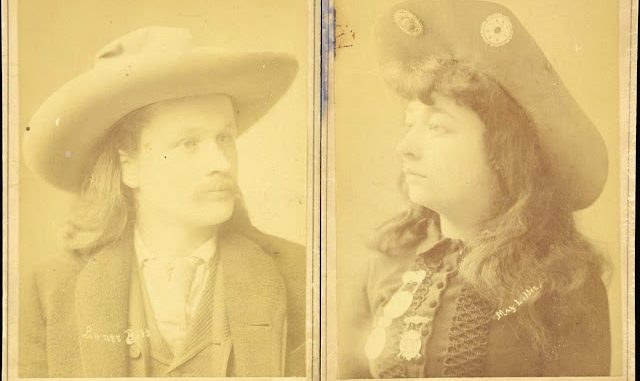
Gordon William “Pawnee Bill” Lillie (1860–1942) and Mary Emma “May” Manning Lillie (1869–1936) were a real-life Wild West power couple: he a showman, interpreter, and rancher; she a sharpshooter and equestrian who became a star of their shows. Their story blends romance, frontier entrepreneurship, show-business spectacle, buffalo conservation, and personal tragedy.

Gordon Lillie was born February 14, 1860, in Bloomington, Illinois. His family later moved to Kansas. As a young man he worked as a cowboy, trapper, teacher, and interpreter at the Pawnee Agency in Indian Territory. The Pawnee gave him the nickname that stuck: Pawnee Bill. In 1883 he joined Buffalo Bill Cody’s newly formed Wild West show as interpreter and performer with a Pawnee contingent.
May Manning was born March 12, 1869, in Philadelphia to a Quaker family; her father was a physician. She was educated and refined (sources note she attended or graduated from Smith College). In 1883–1885, while the Buffalo Bill show was in Philadelphia, the teenage May watched a parade or performance and caught the eye of the long-haired, buckskin-clad Gordon. He was smitten; she later recalled thinking him “a funny man.” They courted by letter for about two years while she finished school. Her parents initially objected to their refined daughter marrying a cowboy, but eventually consented.
They married on August 31, 1886, at her parents’ home in Philadelphia. Gordon’s wedding gifts included a pony and a Marlin .22 target rifle, practical presents that foreshadowed her future career.
Encouraged by May’s family, Gordon launched his own troupe in 1888: Pawnee Bill’s Historic Wild West (later expanded with names such as Historical Wild West, Indian Museum and Encampment). The first season struggled financially, but the show recovered and became successful, touring the U.S. and Europe for years. At its height it employed hundreds of people, hundreds of horses, cattle, buffalo, and other animals.
May quickly became a star. She learned to shoot (starting with prairie chickens) and to perform trick riding, always riding sidesaddle in a full skirt. Billed as the “Champion Girl Horseback Shot of the West,” “greatest Lady Horseback Rifle-shot of the World,” “Princess of the Prairie,” or “New Rifle Queen,” she wowed audiences with accurate shooting from horseback. She was one of the early women to star as both equestrian and sharpshooter in Wild West shows. Some accounts note she lost two fingers in a shooting accident around 1899 but continued performing.
One source links her determination to perform with personal grief: shortly after marriage they had a son who died at about six weeks old; watching Gordon work with horses helped pull her out of despair and into the show life. Gordon also played a public role in the 1889 Oklahoma Land Run as a leader of “Boomers” seeking the opening of the Unassigned Lands; this raised his profile and helped relaunch the show successfully.
Leave a Reply