
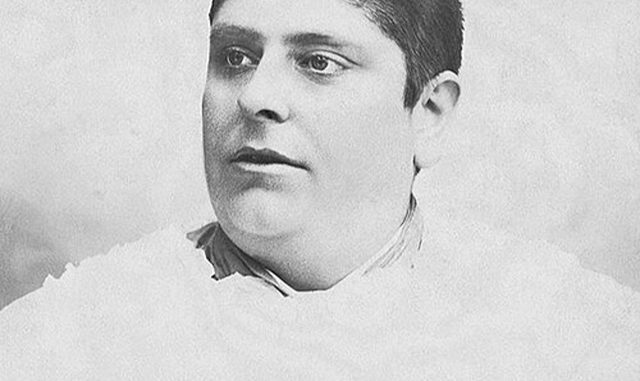
Alessandro Moreschi (1858–1922) was an Italian singer known as “l’Angelo di Roma” (the Angel of Rome). He was the last castrato to serve in the Sistine Chapel Choir and the only one whose voice was recorded.
 |
| Alessandro Moreschi, ca. 1900 |
He was born Alessandro Nilo Angelo Moreschi on November 1, 1858 in the small town of Monte Compatri, near Frascati in the Papal States (now Lazio, Italy). He came from a modest Roman Catholic family; his parents were Luigi Lorenzo Moreschi and Rosa Maria Potelli. He was one of several children (accounts vary between the sixth, seventh, or eighth).
As a boy he sang in the local chapel of the Madonna del Castagno. His clear voice attracted attention. Around age 7–9, he was castrated. The official story often given was that the operation treated an inguinal hernia, a common medical excuse of the era, since castration was still sometimes viewed as a remedy for certain conditions. In reality, it was almost certainly done to preserve his high singing voice for a career in church music, following a centuries-old Italian tradition. Talent scouts for the papal choirs sought out promising boys; one key figure was Nazareno Rosati, a former Sistine Chapel singer.
By about 1870–1871, Rosati brought him to Rome. There he studied at the Scuola di San Salvatore in Lauro under Gaetano Capocci, the distinguished maestro di cappella of the Basilica of St. John Lateran.
In 1873, at only 15, Moreschi was appointed First Soprano at St. John Lateran. He also performed in the salons of Roman high society. His breakthrough came in 1883 when he sang the florid coloratura role of the Seraph in Beethoven’s oratorio Christus am Ölberge (in Italian translation). The performance earned him the nickname “l’Angelo di Roma.” Shortly afterward he joined the Sistine Chapel Choir as First Soprano, a position he held for roughly thirty years.
 |
| Young Alessandro Moreschi, ca. 1880 |
He rose within the choir hierarchy, serving at times as secretary, director of the concertisti, and even temporary maestro. He also sang with other papal chapels (including the Cappella Giulia). Outside the Vatican he was a sought-after soloist. A high point came on August 9, 1900, when, at the request of the Italian royal family, he performed as soloist at the Pantheon under Pietro Mascagni for the funeral rites of the assassinated King Umberto I; he received a gold watch in thanks.
Physically, castrati typically remained beardless, with elongated limbs, a somewhat expanded ribcage, and a youthful appearance into middle age, traits Moreschi shared. Contemporary listeners described his voice as pure, ethereal, and “supernatural.”
Leave a Reply