
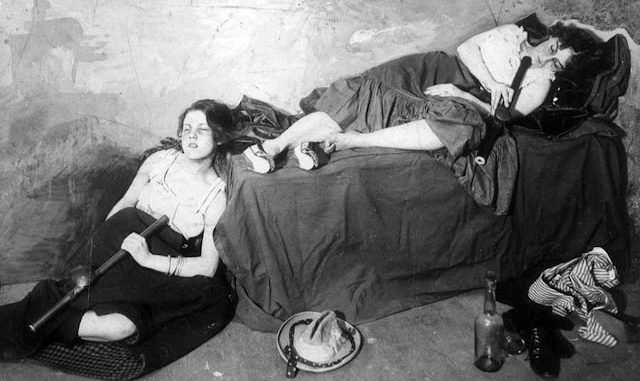
Opium dens were establishments where opium was sold and smoked, typically in reclining positions using long pipes heated over oil lamps. They flourished from the mid-to-late 19th century into the early 20th century across China, Southeast Asia, North America (especially Chinatowns), parts of Europe, and Australia.
Chinese immigrants brought the practice to the United States during the California Gold Rush (around 1850 onward). San Francisco’s Chinatown became an early hub, with dens often in basements, back rooms, or upstairs spaces of laundries and boarding houses. These were tightly sealed to protect the lamps from drafts and contain the distinctive fumes. The habit spread eastward to cities like New York (notably Mott and Pell Streets), Denver, Portland, and others, as well as Canadian Chinatowns in Victoria and Vancouver. Similar dens existed in Australian gold-rush areas (e.g., Melbourne, Ballarat) and, to a lesser and often exaggerated extent, in London’s Limehouse district.
In China itself, dens ranged widely by class: opulent ones for the affluent and sparse ones for laborers. Western dens mirrored this range. Many Chinese smokers used opium as an escape from loneliness, hard labor, prejudice, and homesickness. By the 1870s–1890s, non-Chinese patrons, including white Americans of various classes, from underworld figures to middle- and upper-class individuals, and both men and women, frequented them. Some dens became mixed-race spaces.
Unlike bars or taverns designed for standing or sitting upright, opium dens were laid out specifically for patrons to lie down on their sides. Because smoking opium (chandoo) required heating a viscous paste over a small oil lamp while balancing a heavy pipe, resting on one’s side was both ergonomically necessary and essential for safety. Dens featured low wooden platforms, raised bamboo beds, or cushioned divans. In basic establishments, smokers shared wide wooden couches covered with straw mats or simple fabric; upscale establishments offered carved teak benches, silk pillows, and porcelain headrests.
Dens were typically dim and heavily insulated from drafts, as open air currents could extinguish or fluctuate the flame of the opium lamp. The air held a heavy, sweet, burnt-herbal aroma distinct from tobacco smoke. Establishments employed attendants (often called “cooks” or pipe-masters) who prepared the opium spheres, heated them over oil burners, loaded the clay pipe bowls, and handed them to patrons.
Peak popularity in the U.S. came in the 1880s and 1890s. Opium was initially legal or loosely regulated. Concerns, fueled by moral reformers, temperance advocates, and anti-Chinese sentiment, led to local bans (San Francisco’s 1875 ordinance was among the earliest anti-drug laws targeting dens), the Chinese Exclusion Act of 1882 (which also restricted opium imports), the Pure Food and Drug Act of 1906, and the Smoking Opium Exclusion Act of 1909. Public burnings of confiscated opium and pipes occurred. Dens were driven underground but persisted in some places into the mid-20th century (New York’s last known one closed in 1957; some Australian dens lasted into the 1950s).
Period accounts mixed genuine observation of addiction and squalor with heavy racial stereotyping, claims of dens luring and “corrupting” white women, associations with crime or moral decay, and “Yellow Peril” tropes. Many such narratives were exaggerated or false; dens attracted diverse patrons, and smoking also occurred privately in homes. Photographs from the era show both ordinary Chinese smokers and mixed groups reclining with pipes, sometimes appearing relaxed rather than purely degraded.


Leave a Reply