The omnipresence of the bicycle and bike culture in 1890s Toronto far surpasses anything we know today. But remarkably, the political issues associated with cycling are almost unchanged.
In the 1890s Toronotonians were preoccupied with the question of ‘scorchers’: those riders who traveled too quickly, ignored rules of the road, and endangered pedestrians. Similarly, there was a concerted effort to improve the quality of the city’s streets for cyclists. The ‘Good Roads Campaign’ argued that city council needed to set aside more money to pave roads for the benefit of the bike rider. Though, unlike today, their priority was to make suburban roads more bike-friendly to allow for people to leave the city easily on weekends.
Finally, cyclists successfully courted political power. Candidates for both the mayoralty and council made a point of wooing the biking lobby, often showing up at meetings of cyclists to expound upon their respective platforms. If there was an important question in Toronto, the bike unions were sure to be involved somehow.
By the end of World War II, however, the cycling heyday was over. Cycling as something like a movement, or aspect of civic consciousness, or popular sport, didn’t really return until the 1980s, and gain serious momentum in the 2000s.
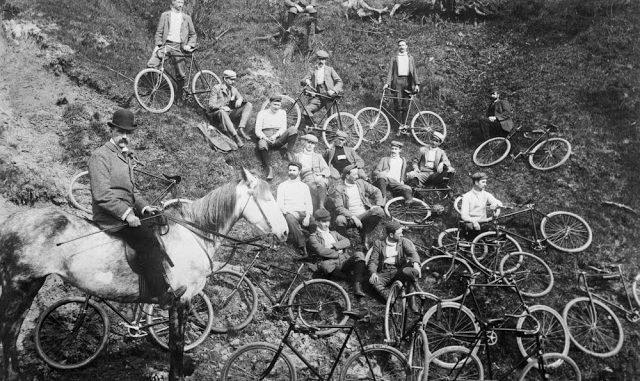
Cycling club in Toronto, 1900
A leisurely ride Jarvis Street, 1903
Bay Street, 1907
Boys cycling across Lakeshore Road bridge at Mimico, 1907



Leave a Reply