
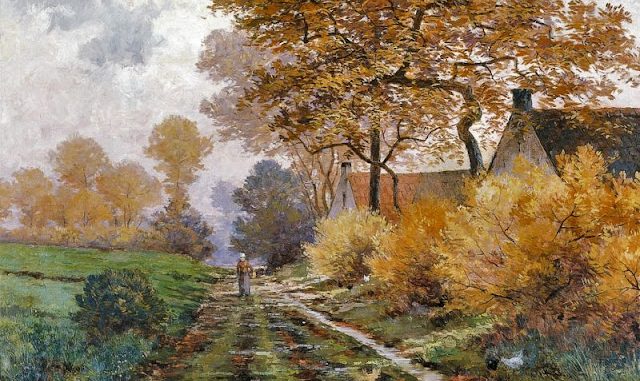
Rodolphe Wytsman (1860–1927) was a Belgian painter associated with the Symbolist and Impressionist movements, known particularly for his landscape and nature paintings. He was influenced by the Symbolist movement in his early career, which emphasized mood and atmosphere over strict realism.
As an artist, Wytsman is best known for his skillful use of light and color in capturing the natural world, particularly in landscapes and botanical scenes. His style evolved over time, and he eventually became known for his approach to Impressionism, drawing comparisons to the work of the French Impressionists, particularly Claude Monet.
Wytsman’s works often depict the Belgian countryside, with lush foliage, floral studies, and the changing seasons. His ability to convey the subtleties of light, texture, and atmosphere was one of the hallmarks of his art.
In addition to his fine art career, Wytsman also taught at the Royal Academy in Brussels, where he influenced a generation of young Belgian artists. His work was exhibited widely, and he was a respected member of the Belgian artistic community.
Though he was not as internationally renowned as some of his contemporaries, Wytsman is still regarded as an important figure in the development of Belgian art during the late 19th and early 20th centuries. His works are now housed in various collections, including the Royal Museums of Fine Arts in Belgium.
Here below is a set of beautiful landscape and nature paintings by Rodolphe Wytsman in the late 19th and early 20th centuries.
 |
| Path in autumn |
 |
| After the storm, Brabant |
 |
| April morning |
 |
| Autumn day |
 |
| Autumn morning – the pond |
Leave a Reply