
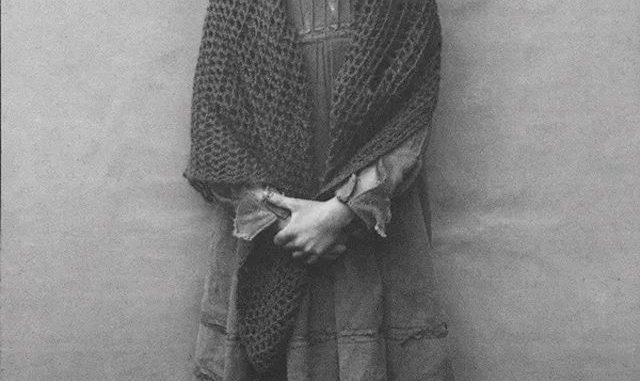
The photograph of Adelaide Springett, captured in 1901 by Horace Warner, is one of the most poignant images from a collection known as the “Spitalfields Nippers.” For over a century, these photographs sat quietly in a family album, completely unknown to the public. When they finally came to light, they revealed a rare, dignified look at childhood in the absolute poorest slums of East London at the turn of the 20th century.

When Horace Warner took her portrait in 1901, Adelaide was just eight years old. Warner, a Sunday School superintendent and a Quaker wallpaper designer, ironed out a specific title for the photo: “Adelaide Springett in All Her Best Clothes.”
The visual reality of the image sharply contrasts with that title, carrying a heartbreaking detail that became central to her story. According to family recollections passed down by Warner’s daughter, Ruth, little Adelaide was so deeply ashamed of the tattered, ruined state of her footwear that she refused to wear them for the picture. If you look closely at her bare feet in the photograph, she isn’t just shoeless, one of her feet is wrapped carefully in a makeshift cloth bandage to protect it from the harsh, filthy London streets.
Ruth Warner recalled that her father kept a print of Adelaide’s portrait hanging on their living room wall throughout her childhood. He jokingly but tenderly nicknamed it “Little Adelaide’s best and only boots,” serving as a constant, humbling reminder to his own family of the stark privileges they enjoyed compared to the East End children.

Adelaide’s early life was framed by the extreme poverty of the Victorian and Edwardian underclass. The statistics of the “Nippers” families were grim: while London’s general childhood mortality rate was one in five, researchers found that one in three children in Warner’s Spitalfields portraits did not survive to adulthood.
Adelaide’s parents were costermongers (street sellers) and casual dock laborers. She suffered immense family loss early on: her twin sisters, Ellen and Margaret, died at birth, and another sister, Susannah, died when she was only four years old.
Around the time the photo was taken in 1901, school and housing records show Adelaide and her mother were living at a Salvation Army Shelter on Hanbury Street, and previously at Miller’s Court, Dorset Street, the notorious, crime-ridden alleyway where Jack the Ripper’s final victim, Mary Jane Kelly, had been murdered just over a decade earlier.
Despite a childhood defined by unimaginable hardship, parental loss (her mother later died of alcoholism at 47 and her father vanished from records entirely), and an adulthood marked by further personal tragedy, Adelaide possessed incredible resilience.
She spent her youth working in domestic service, survived both World Wars, and lived an exceptionally long life. She passed away in a nursing home in Fulham in 1986 at the age of 93. Because she died without any traceable immediate relatives, the local social services department acted as her executor, completely unaware that the quiet, elderly woman had once been the striking, unforgettable face of London’s forgotten children.
Leave a Reply