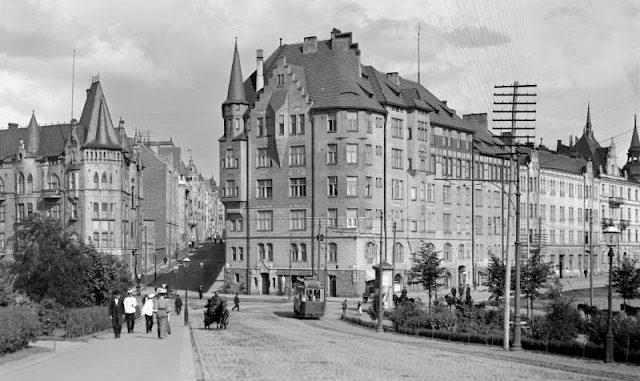
In the early 1900s, Helsinki’s street scenes reflected a city in transition—balancing tradition and emerging modernity. Horse-drawn carriages clattered over cobbled streets lined with ornate stone buildings in Jugendstil (Art Nouveau) style. Street vendors sold goods from wooden carts, and women in long skirts and men in bowler hats bustled along the sidewalks.
Trams, first introduced in 1891, were becoming a common sight, weaving through the streets powered by overhead electric lines. Children played near market squares, while fishermen brought fresh catches into the harbor. The air carried the scent of coal smoke and sea breeze. Streetlights—still gas in some areas—glowed dimly at dusk, casting long shadows over Senate Square and the grand Helsinki Cathedral.
Though modest in size, the city buzzed with the energy of a growing capital, still under Russian rule yet increasingly proud of its Finnish identity. These fascinating photos, taken by I. K. Inha (1865–1930), offer a rare glimpse into Helsinki’s street scenes during the summer of 1908.
Corner of Satamakatu, Luotsikatu and Kruununvuorenkatu on Katajanokka, Helsinki, 1908
Aleksanterinkatu, Helsinki, 1908
Boys at Hietalahti harbor, Helsinki, 1908
Crossing of Aleksanterinkatu and Unionkatu, Helsinki, 1908
Crossing of Tehtaankatu and Kapteeninkatu, Helsinki, 1908



Leave a Reply