
Pasta is an integral part of Italy’s food history. Wherever Italians immigrated they have brought their pasta along, so much so that today it can be considered a staple of international cuisine.
 |
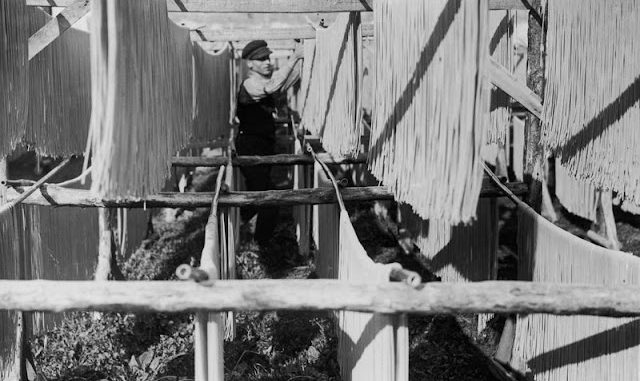
| Pasta strands hung out to dry at a factory in Naples, Italy, 1925. |
The first concrete information concerning pasta products in Italy dates from the 13th or 14th century. There is also a legend of Marco Polo importing pasta from China which originated with the Macaroni Journal, published by an association of food industries with the goal of promoting pasta in the United States. Jeffrey Steingarten asserts that Arabs introduced pasta in the Emirate of Sicily in the ninth century, mentioning also that traces of pasta have been found in ancient Greece and that Jane Grigson believed the Marco Polo story to have originated in the 1920s or 1930s in an advertisement for a Canadian spaghetti company.
The modern word “macaroni” derives from the Sicilian term for kneading the dough with energy, as early pasta making was often a laborious, day-long process. How these early dishes were served is not truly known, but many Sicilian pasta recipes still include typically middle eastern ingredients, such as raisins and cinnamon, which may be witness to original, medieval recipes. This early pasta was an ideal staple for Sicily and it easily spread to the mainland since durum wheat thrives in Italy’s climate.
 |
| Pasta is hung out to dry in a market. |
The modern word “macaroni” derives from the Sicilian term for kneading the dough with energy, as early pasta making was often a laborious, day-long process. How these early dishes were served is not truly known, but many Sicilian pasta recipes still include typically middle eastern ingredients, such as raisins and cinnamon, which may be witness to original, medieval recipes. This early pasta was an ideal staple for Sicily and it easily spread to the mainland since durum wheat thrives in Italy’s climate.
By the 1300s dried pasta was very popular for its nutrition and long shelf life, making it ideal for long ship voyages. Pasta made it around the globe during the voyages of discovery a century later. By that time different shapes of pasta have appeared and new technology made pasta easier to make. With these innovations, pasta truly became a part of Italian life.
 |
| Pasta in Naples, 1925. |
 |
| Italian boys showing drying pasta, 1928. |
 |
| A worker hangs pasta to dry in a factory in Italy, 1932. |
Leave a Reply