Over the years, many facts have been misinterpreted about the famous and ruthless explorer.
1 of 12
The Nina, the Pinta, and the Santa Maria often go by the wrong names. The Nina was actually called “la Santa Clara,” the Pinta was known as “la Pintada,” Spanish for “the painted one,” and the Santa Maria was actually called “la Gallega.” Even more interesting? Though scientists around the world have discovered shipwrecks dating back to Columbus’s time, no one has ever located the remains of the First Fleet. Scientists attribute the mystery to the warm waters of the Caribbean, the ever-changing landscape of the region, and the fact that we only know for sure what happened one of the vessels. Wikimedia Commons
2 of 12
Though many people refer to Columbus as the man who “discovered America,” the truth is, the man never set foot on North American Soil. When he arrived in what he thought was India, he was actually in the Caribbean, on the islands that are now the Bahamas. Over the course of his journey, he explored various other islands and territories along the coast, but the closest that he got to US soil was actually Central America. Wikimedia Commons
3 of 12
Everyone knows of Columbus’ atrocities against the natives. However, not many people know that he was eventually persecuted for it. When news of his brutal tyranny got back to Spain, King Ferdinand and Queen Isabella dispatched a royal commissioner to Hispaniola to arrest Columbus. When he was brought back to Spain, he was stripped of his governorship. Wikimedia Commons
4 of 12
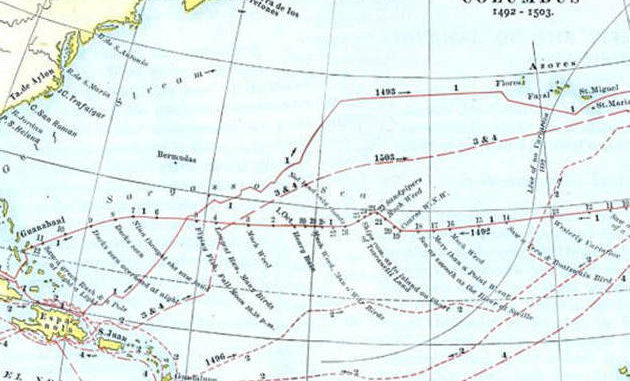
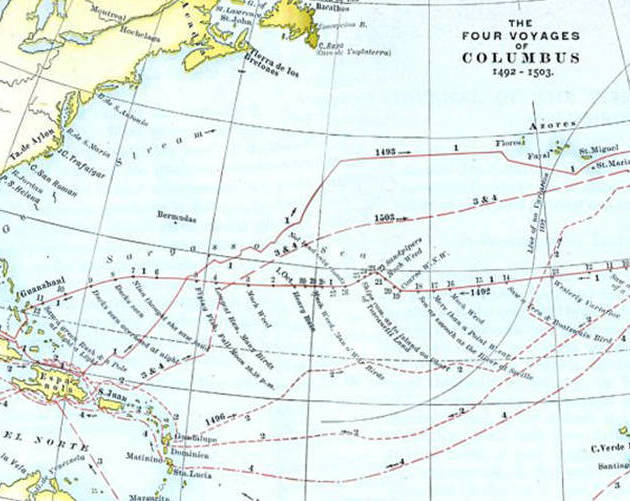
Although Columbus is best known for his historic 1492 voyage, the explorer actually made four separate journeys. His first, in 1492, took him to the Caribbean, his second to South America, and his third and fourth to Central America. Wikimedia Commons
5 of 12
Tales of Columbus cutting off the hands of native islanders, and executing fellow Spanish colonists were widespread not just through the colonies, but back to Spain as well. However, though Columbus perpetuated the tyrannical ideas, he is not responsible for coming up with them. The European mindset was very much that anything the America’s had to offer was theirs for the taking. Rich European conquistadors would hear tales of riches coming from the Spanish conquests of South America and turned greedy. They’d then set off on their conquests, driven by their desires.Wikimedia Commons
6 of 12
Since Columbus’s death in 1506, the whereabouts of the explorer’s remains have been a mystery. After being moved from Valladolid, Spain to Seville, his daughter-in-law requested that his body, and the body of his son, Diego, be moved across the sea to Hispaniola, and buried in a cathedral in Santo Domingo. In 1795, after the French captured the region, the Spanish dug up the remains and returned them to Seville. However, in 1877, a box of human remains was discovered in the Santo Domingo cathedral, bearing Columbus’ name. In 2006, DNA testing revealed that at least some of the remains in Seville are Columbus’s, but not all. To this day, the whereabouts of his entire body are unknown, and historians believe he could be, appropriately, buried in both the New and Old World. Wikimedia Commons
7 of 12
While many people consider Columbus to be the first European to set foot in the New World, he actually was far from it. Most historians believe that Leif Erikson was the first European to reach the Americas. The Norse explorer is said to have reached the shores of Newfoundland some 500 years before Columbus set sail. Some historians believe that Phoenician explorers crossed the Atlantic even earlier than that. Wikimedia Commons
8 of 12
A common misconception about Columbus is that he set out to prove that the Earth was round. Kids in elementary schools are often taught that he feared he would fall off the edge if he didn’t reach the East Indies in time. However, what most people don’t know is that as early as the sixth century, Pythagoras was theorizing that the earth was a sphere. There is no doubt that Columbus was fully aware that the Earth was round, especially since he owned a personal copy of Ptolemy’s ‘Geography,’ which refers to the Earth as round.Wikimedia Commons
9 of 12
Before King Ferdinand and Queen Isabella agreed to finance Columbus’ grand adventure, the explorer was turned down multiple times. Advisors to the king of England, Henry VII and the king of France, Charles VIII warned the monarchs that the explorer’s calculations were wrong, and that the voyage would be a long waste of money. Even Ferdinand and Isabella rejected Columbus at first, though eventually they came around. In the end it turned out that Columbus’s calculations were actually wrong. He dramatically underestimated the earth’s circumference, and it was by sheer luck that he ran into the Americas. Wikimedia Commons
10 of 12
Even after Columbus’ death, he was causing problems for the Spanish monarchy. After he died, his heirs wrapped the Spanish crown up in a harrowing legal battle, claiming that the monarchy had short-changed Columbus on the profits he was due. Though most of the lawsuits were filed and settled by 1536, there were still legal proceedings being carried out by the 300th anniversary of his voyage. Wikimedia Commons
11 of 12
Columbus Day became a federal holiday in 1937, in part because of efforts by Roman Catholic Italian Americans. In the 19th and early 20th century, members of the stigmatized ethnic and religious group successfully campaigned for the holiday to place Catholic Italians, like Christopher Columbus, into American history. Their crusade out people of Anglo-Saxon descent who wanted a federal holiday honoring Leif Erikson as the first European to reach the Americas.Wikimedia Commons
12 of 12
Like this gallery? Share it:
11 Christopher Columbus Facts That Everyone Gets Wrong
View Gallery
“In 1492, Columbus sailed the ocean blue…”
Just about everyone knows the story. The Italian explorer Christopher Columbus sailed from Spain to the Americas in 1492, thinking he’d discovered a shortcut to the East Indies. Upon arrival, he pillaged the villagers, looted their resources, and infected them with syphilis, typhoid, and smallpox.
For the most part, these Christopher Columbus facts are true. Columbus did sail from Europe to the Americas, and once he got there, he was a ruthless leader, driven by greed and possessing a pirate-like mentality. But, at a time when imperialism was at an all-time high, and every power in Europe was driven by economic competition, Columbus was merely one in a sea of many as ruthless as he was.
Due to his less-than-spotless reputation, countless Christopher Columbus facts and trivia tidbits have been misconstrued and misattributed to the famed explorer over the years.
For example, his name. Though we know him as Christopher Columbus, that’s just an Americanized version. The explorer’s real name was Cristoforo Colombo, and he wasn’t quite Italian. He was born in the Republic of Genoa, which though it now lies in Italy, was its own region then. The country of Italy wasn’t established until after Columbus’s death.
Though he’s gone from explorer to monster, and from governor to pariah, one thing can be said about Columbus– he was responsible for bridging the gap between the New World and the Old World, and bringing international attention to the Americas.

Leave a Reply