
Born in 1394, Charles d’Orléans was a member of the French royal family, the grandson of King Charles V of France (r. 1364–1380) and nephew of King Charles VI (r. 1380-1422). He became Duke of Orléans at the age of fourteen after the assassination of his father. On 25 October 1415, Charles fought at the Battle of Agincourt when France was catastrophically defeated by England. The twenty-one-year-old was captured on the battlefield and brought back to England where he remained as a political prisoner for the next twenty-five years. He was finally released in 1440 and spent the last years of his life in France, dying in 1465.
Despite the political turmoil that surrounded his life, Charles is best remembered as a gifted writer of romantic, witty and sometimes wistful poetry. He wrote over 500 poems in the course of his life, with a particularly prolific period during his years of captivity. Charles wrote in both Middle French and Middle English, the latter of which he learned to speak fluently while in England.
Charles has been credited with writing the first Valentine card, in the form of a poem for his wife. Charles wrote the poem in 1415 at age 21, in the first year of his captivity while being held prisoner in the Tower of London after having been captured by the British at the Battle of Agincourt. The Battle of Agincourt forms the centerpiece of Shakespeare’s historical play Henry V, in which Charles appears as a character with a number of lines. At age 16, Charles had married the 11-year-old Bonne of Armagnac in a political alliance, which explains the age difference he mentions in his poem. Unfortunately, Charles would be held prisoner for a quarter century and would never see his wife again, as she died before he was released.
 |
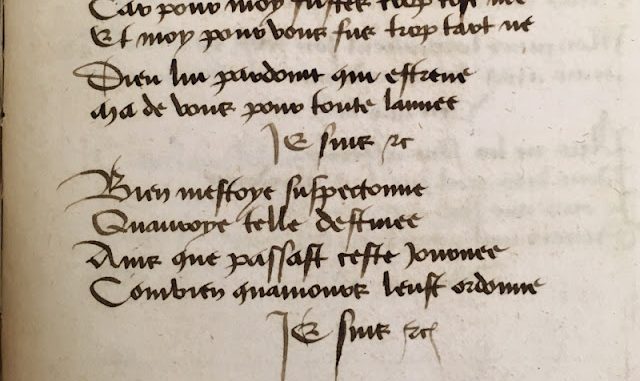
| Beginning of Charles’ poem “Je suis desja d’amour tanné,” in a 15th-century copy of his personal manuscript. |
Je suis desja d’amour tanné,
Ma tres doulce Valentinée,
Car pour moi fustes trop tart née,
Et moy pour vous fus trop tost né.
Dieu lui pardoint qui estrené
M’a de vous, pour toute l’année.
Je suis desja d’amour tanné,
Ma tres doulce Valentinée.
Bien m’estoye suspeconné,
Qu’auroye telle destinée,
Ains que passast ceste journée,
Combien qu’Amours l’eust ordonné.
Je suis desja d’amour tanné,
Ma tres doulce Valentinée.
(I am already sick of love,
My very gentle Valentine,
Since for me you were born too late,
And I for you was born too soon.
God forgives him who has estranged
Me from you for the whole year.
I am already sick of love,
My very gentle Valentine.
Well might I have suspected
That such a destiny,
Thus would have happened this day,
How much that Love would have commanded.
I am already sick of love,
My very gentle Valentine.)
Leave a Reply