
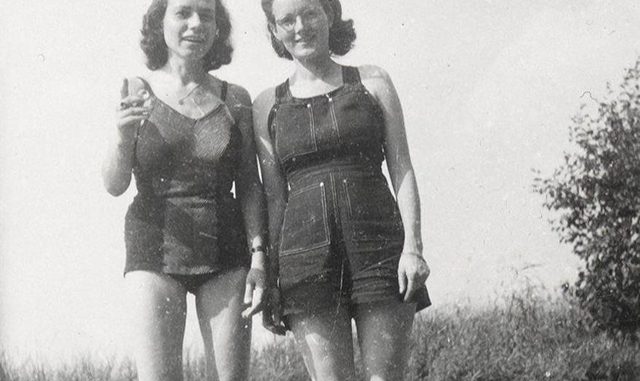
Felice Schragenheim and Lilly Wust, photographed by the Havel river on August 21, 1944, laughing, embracing, using a timer to photograph themselves in the sun. Hours later they went home and found the Gestapo waiting. These are the last photos ever taken of them together.


Felice Schragenheim (nicknamed “Jaguar”) and Elisabeth “Lilly” Wust (nicknamed “Aimée”) shared a passionate, high-risk lesbian relationship in Nazi Berlin during World War II. Their story is documented through surviving letters, poems, photos, diaries, and Lilly’s later recollections; it formed the basis of Erica Fischer’s 1994 book Aimée & Jaguar and the 1999 German film of the same name.
In November 1942, the two women were introduced at a café in Berlin. On the surface, they belonged to completely different, violently opposed worlds. Elisabeth Wust was a 29-year-old German woman, married to a Wehrmacht soldier who was away at the front. She was the mother of four sons and a recipient of the Nazi “Mother’s Cross,” living a relatively privileged life as an exemplar of Nazi womanhood. Felice Schragenheim was a 20-year-old Jewish woman living in hiding. After her grandmother was deported, Felice assumed a fake identity (“Felice Schrader”) and actively worked with the Jewish underground resistance. She even managed to get a job working at a Nazi-run newspaper to maintain her cover.
Felice, fascinated by the danger and drawn to Lilly, took the initiative to woo her. The two began a passionate secret relationship, communicating through a flurry of love letters and poems. In their writings, they adopted the pet names that would later make their story famous: Felice became “Jaguar” and Lilly was “Aimée” (French for “beloved”).
As their relationship deepened, the stakes grew impossibly high. When Felice finally revealed her true identity as a Jewish resistance worker, Lilly did not turn her in. Instead, she vowed to protect her. Lilly filed for divorce from her husband, and in May 1943, Felice moved into Lilly’s home, ostensibly acting as a caretaker for Lilly’s children.
In June 1943, the couple drafted their own marriage contract, and a few months later, they exchanged rings, an extraordinary act of commitment and queer defiance in the heart of the Third Reich.
 |
| Lilly’s “books of tears”: Berlin, August 21, 1944 – February 28, 1945. This is the first of a total of four diaries by Lilly Wust, which she began on the day Felice was transported away, August 21, 1944. It is written in the green ink that Felice used for her letters and poems. |

 |
| Marriage contract between Elisabeth Wust and Felice Schragenheim, Berlin June 26, 1943. |
Leave a Reply