
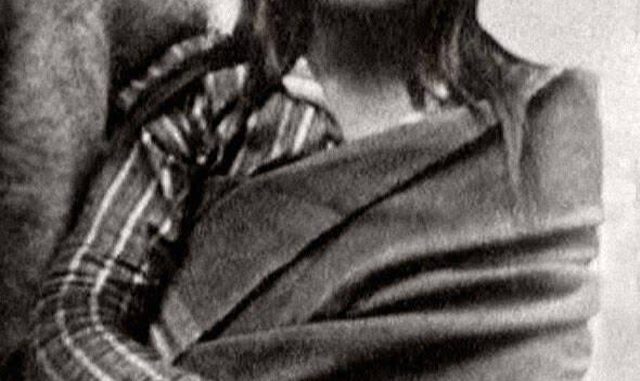
Juana Maria, better known as the “Lone Woman of San Nicolas Island,” was a Native American woman of the Nicoleño people whose real name is unknown. She lived alone (or nearly alone) on San Nicolas Island, the most remote of California’s Channel Islands, about 60 miles (97 km) off the southern California coast for 18 years, from 1835 until 1853. Her story inspired Scott O’Dell’s 1960 Newbery Medal-winning children’s novel Island of the Blue Dolphins (in which she is fictionalized as the character Karana).
 |
| A photograph of a Native American woman, believed to be Juana Maria. This photograph was found alongside a picture of Maria Sinforosa Ramona Sanchez, wife of George Nidever, with whom Maria had lived at the Santa Barbara Mission. |
The Nicoleño (closely related to the Tongva) had lived on San Nicolas for thousands of years. In 1811–1814, a party of Native Alaskan (primarily Alutiiq/Kodiak) sea otter hunters working for the Russian-American Company massacred many of the island’s men after conflict, severely reducing the population. By the early 1830s only a small number of Nicoleños remained.
In late 1835 the schooner Peor es Nada (“Better Than Nothing” or “Nothing Is Worse”), under Charles Hubbard, was sent to remove the remaining islanders to the mainland. Most boarded, but Juana Maria did not. Traditional accounts say a sudden storm forced the ship to leave urgently; a more romantic later version (appearing decades afterward) claims she jumped overboard after realizing a child (sometimes described as an infant or younger brother) had been left behind. Modern research, drawing on Native Californian testimony recorded by ethnologist John Peabody Harrington, indicates she may have voluntarily stayed because her son refused to board, and that the two lived together on the island until the son, by then an adult, was killed by a shark or orca.
She survived for 18 years through remarkable resourcefulness. She built a hut partly of whale bones and brush (and may have used a nearby cave), wore a skirt or dress of greenish cormorant feathers sewn with sinew, and lived primarily on seal fat/blubber, shellfish, fish, and birds. She made tools (including hooks from shells and a knife from an iron hoop), baskets, and other items. Hunters occasionally reported signs of her presence but failed to locate her for years.
Santa Barbara Mission priest José González Rubio funded searches. Fur trapper-captain George Nidever made multiple trips. On his third attempt in autumn 1853, crew member Carl Dittman found footprints and drying seal blubber. They located her in her whale-bone hut. Accounts describe her as about 50 years old, of medium height and sturdy build, strong and active, with a pleasant, smiling face and worn but complete teeth. She was friendly, offered food, showed no fear, and willingly returned with them to Santa Barbara after about a month.
She stayed with the Nidever family. She was fascinated by horses, European clothing, and foods, and reportedly enjoyed singing and dancing for visitors. Communication was extremely limited, local Chumash and even Tongva speakers could not fully understand her Nicoleño language (a Uto-Aztecan tongue; a few words and songs were later recorded, including one known as the “Toki Toki” song). She was nicknamed things like “the wild woman” or “Better Than Nothing.”
Just seven weeks after arrival she died of dysentery (October 19, 1853), possibly worsened by sudden exposure to richer mainland foods such as green corn, vegetables, and fruit, or by disease to which she had little immunity. On her deathbed she was conditionally baptized by Father Francisco Sánchez and given the name Juana Maria. She was buried in an unmarked grave in the Nidever family plot at Mission Santa Barbara cemetery. A commemorative plaque was later placed there. Most of her artifacts (including clothing and a water basket) were lost in the 1906 San Francisco earthquake and fire.
Her story became a California legend, amplified by 19th-century newspaper accounts that portrayed her in romanticized “Robinson Crusoe” or “last of her race” terms. Archaeological work has located her hut site and a possible cave, plus artifact caches. Recent scholarship has revised older narratives: she was not necessarily the absolute last Nicoleño, the removal was more complex than a simple missionary rescue after the massacre, she could communicate to some degree with certain Native people, and she exercised agency in remaining on the island with her son rather than being purely abandoned. The Pechanga Band of Luiseño Indians has asserted cultural affiliation, leading to pauses in some archaeological work.
A historically informed portrait of her (based on contemporary descriptions) was unveiled by the Santa Barbara Museum of Natural History, and a statue stands in Santa Barbara. Her life remains a powerful story of Indigenous resilience, isolation, and the devastating impacts of colonization, disease, and cultural disruption on California’s Native peoples.
 |
| Statue of Juana Maria and child in Santa Barbara, California, at the intersection of State Street & Victoria Street. |
Leave a Reply