On March 3, 1913, over 5,000 women marched down Pennsylvania Avenue in Washington, D.C. for universal women’s suffrage. The event was scheduled on the day before President Woodrow Wilson’s inauguration to “march in a spirit of protest against the present political organization of society, from which women are excluded,” as the official program stated. The march and the attention that it attracted were monumental in advancing women’s suffrage in the United States.
German actress Hedwig Reicher wears the costume of “Columbia” with other suffrage pageant participants standing in background in front of the Treasury Building in Washington, District of Columbia, on March 3, 1913. The performance was part of the larger Suffrage Parade of 1913.
The event was organized by Alice Paul, who was born in New Jersey and earned an M.A. and Ph.D. from the University of Pennsylvania. She traveled to England and became involved with the suffrage movement. Upon her return to the United States, she joined the National American Woman Suffrage Association. The Washington parade was her first duty as part of the suffrage association.
Suffragist Alice Paul, in a 1913 photograph. Paul was born in New Jersey, earned an M.A. and Ph.D. from the University of Pennsylvania, then traveled to England and became friends with members of the women’s suffrage movement there. She soon became very active herself, and, on returning to the United States soon after, joined the National American Woman Suffrage Association (NAWSA). Her first actions as part of NAWSA were to organize a massive parade in Washington, District of Columbia, to promote a new constitutional amendment that would guarantee women’s right to vote in the U.S.
The parade included nine bands, four mounted brigades, 20 floats, and an allegorical performance near the Treasury Building. The marchers were separated into different categories.
Leading the parade, wearing a crown and long white cape on top of a white horse, was labor lawyer Inez Milholland. Women from countries that had already enfranchised women were first, along with officers in the National American Woman Suffrage Association.
The “Pioneers”, women who have been working on suffrage for decades, came after. Celebration of working women followed the Pioneers section and included nurses, farmers, homemakers, doctors, college women, and more. Other sections included the National Association of Colored Women, individual state delegations, and male supporters.
Cover of the program for the 1913 women’s suffrage procession.
Elizabeth Freeman of the New York State Suffrage Association, with horse and carriage, on her way to join the March 3, 1913 suffrage march in Washington, District of Columbia.
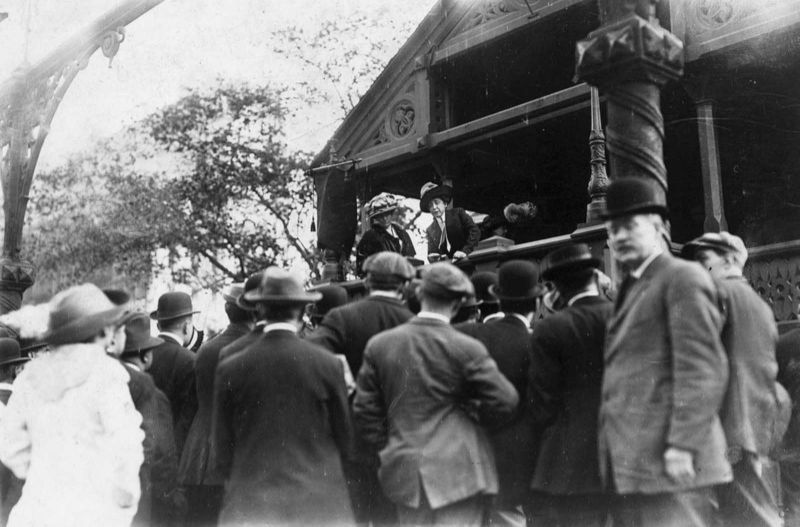
Mrs. E.R. Smith practicing speechmaking from a covered platform before a small crowd, a ‘school for suffragette speakers’ in Union Square.


Leave a Reply