
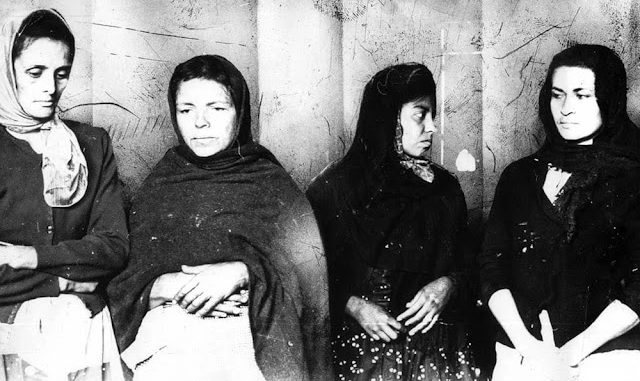
Las Poquianchis, a name that sends shivers down the spine of many in Mexico, refers to the González Valenzuela sisters – María Delfina (1912–1968), María del Carmen (1918–1949), María Luisa (1920–1984), and María de Jesús (1924–1990). Originating from the north-central Mexican state of Guanajuato, these four siblings ran a large-scale prostitution ring and committed numerous murders from 1950 until 1964. Their criminal operation was based at “Rancho El Ángel,” which became infamous as the site of at least 91 murders. However, it is believed that the sisters may have killed more than 150, or even over 200 people. This led to them being recognized by Guinness World Records as the “most prolific murder partnership.”
The sisters grew up in a heavily dysfunctional, highly abusive household under a father who was a law enforcement official, exposing them to violence at an early age. They recruited vulnerable young girls and teenagers from rural areas using deceptive help-wanted advertisements promising legitimate work, such as hiring housemaids. Once the girls arrived at the ranch, they were completely stripped of their freedom. To force compliance, the sisters used severe physical abuse, starvation, and forced drug addiction (primarily heroin and cocaine).
Girls who resisted or tried to escape faced horrific punishments. This included being beaten with nail-studded bats, set on fire, or placed in the cama real (“royal bed”), a narrow wooden board where victims were tightly wrapped in barbed wire for days. If a woman became too sick, pregnant, or unprofitable, she was brutally murdered. The sisters did not stop at their captives; they also robbed and murdered wealthy customers who entered their establishments carrying large sums of cash.
The empire of fear collapsed in January 1964 when a young captive managed to escape the ranch near León and alert local police. Acting on her tip, authorities raided the property and discovered a “concentration camp” housing 19 emaciated survivors. Subsequent excavations of the property turned up mass graves containing the remains of at least 80 young women, several fetuses, and multiple male patrons.
The subsequent trial in 1964 was a media sensation in Mexico. Dozens of former captives testified against the sisters, exposing a vast network of corruption where local officials had been bribed with money and services to look the other way.
Because Mexico did not have the death penalty, the three surviving sisters (Delfina, María Luisa, and María de Jesús) were given the maximum sentence of 40 years in prison. Nineteen of their co-conspirators and henchmen were also jailed. None of the sisters lived to complete their full sentences.
The grim saga deeply scarred Mexican society and has been a prominent fixture in Latin American true crime lore. It famously inspired the critically acclaimed Mexican novel The Dead Girls (Las Muertas) by Jorge Ibargüengoitia, which was later adapted into a 2025 six-part Netflix miniseries titled Las Muertas.
 |
| The González Valenzuela sisters |
 |
| Some women allegedly imprisoned in a ‘white slave concentration camp’ near Leon, Guanajuato, point to Gonzalez Valenzuela. |
 |
| A girl points an accusatory finger at Delfina Gonzalez Valenzuela as Chuy looks on. |

 |
| Delfina and Maria de Jesus Gonzalez Valenzuela |
Leave a Reply