
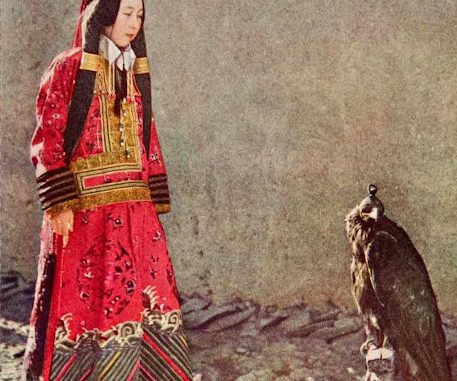
In 1932, a powerful and graceful moment was captured by photographer Maynard Owen Williams for The National Geographic Magazine—Princess Nirgidma of Torhout standing beside her hunting eagle. Dressed in traditional Mongolian attire, the image radiated both nobility and cultural pride.

Princess Nirgidma of Torhout (also known as Nirgidma de Torhout, Princess Palta, or Nina de Torghut) was a remarkable Torghut (Torhout/Torghut) Mongol noblewoman whose life bridged the nomadic traditions of the Central Asian steppes and the cosmopolitan world of 20th-century Europe and Asia.
Born in 1907 in Tokyo, she was the daughter of Prince Palta (a Mongolian statesman, scholar, and governor of the Altai region, educated in military science in Japan) and his Torghut wife Orloma. Her lineage traced back through the Torghut (Oirat/Kalmyk) Mongols to figures like Ayuka Khan and ultimately to Genghis Khan via the Borjigin line. The Torghuts were nomadic Buddhist people famous for their horsemanship, migrations (including from the Volga region back to Central Asia), and warrior-hunter heritage.

Her father emphasized education for all his children, blending Western, Chinese, and traditional elements. Nirgidma studied at the Sacred Heart School in Peking (Beijing), then pursued political science, literature, and music at universities in Paris and Brussels. She became a polyglot, fluent in French, English, Chinese, Russian, Mongolian, and later Persian and Arabic. She traveled widely as a journalist and observer of political and cultural affairs across Central Asia and the Middle East.
Nirgidma embodied a blend of tradition and modernity. She published Dix-Huit Chants et Poèmes Mongols (1937), a collection of Mongolian songs and poems she transcribed, offering rare Western insight into authentic Oirat-Mongol culture. She wrote a foreword for Danish explorer Henning Haslund-Christensen’s book Men and Gods in Mongolia (1935) and contributed an article to The Spectator in 1935 titled “The Disadvantages of Women’s Rights,” reflecting on gender, emancipation, and cultural values. She was friends with intellectuals like Pierre Teilhard de Chardin and sculptor Lucile Swan.
In 1938, she married French diplomat Michel Georges Eugène Bréal (later consul general in China and ambassador to Afghanistan, Laos, and Thailand). They had a son, and she supported her family through turbulent times, including World War II. She lived much of her later life in France, where she died in Paris in 1983 at age 75. She enjoyed horse-riding, gardening, music, and the steppe traditions of her youth.

Contemporary accounts describe her as a slender, charming woman of serene yet lively presence, an oriental beauty who moved effortlessly in Western circles while remaining proud of her Torghut roots. She was independent, intellectually sharp, tolerant, and spiritually inclined—traveling on pilgrimage and valuing both freedom and tradition. Dutch diplomat Carl Barkman, who met her in Peking in 1947, was deeply impressed and later dedicated a novel to her memory.
Leave a Reply