
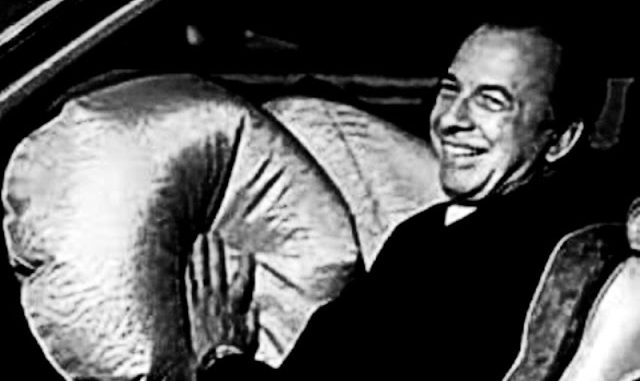
John Willard Hetrick (1918–1999) was an American industrial engineer from Newport, Pennsylvania, widely credited with inventing the automotive airbag. He filed for a U.S. patent on August 5, 1952, for a “Safety cushion assembly for automotive vehicles” and received U.S. Patent No. 2,649,311 on August 18, 1953, the first U.S. patent for an airbag. His design used compressed air to inflate cushions (in locations such as the steering wheel, dashboard/glove box, and potentially seat backs) in response to sudden deceleration, triggered by a spring-loaded sensor. He built an early prototype on his kitchen table.


The idea came from a near-miss accident in spring 1952. While driving a 1948 Chrysler Windsor near Newport, Pennsylvania, with his wife Jeannette and young daughter Joan, Hetrick swerved to avoid a rock (accounts also mention watching for deer) and went into a ditch. He and his wife instinctively threw up their hands to keep their daughter from hitting the dashboard. On the way home he wondered why a protective object couldn’t automatically deploy from the dashboard.
His Navy experience during World War II provided the technical spark. While working on compressed-air torpedoes, he recalled an accidental release of compressed air that rapidly inflated a canvas cover “quicker than you could blink an eye.”
Hetrick received little commercial success or income from the invention. Automakers at the time showed little interest (safety features were not prioritized over styling and features like radios), and widespread adoption of airbags occurred only after his patent expired in 1971.
German engineer Walter Linderer independently patented a similar compressed-air inflatable cushion around the same period (German patent in 1953). Practical modern systems later required faster chemical inflation (e.g., sodium azide-based propellants) and better sensors (notably advances by Allen Breed in the late 1960s).
Hetrick was later awarded the Golden Gear Award for his contribution. Airbags have since become a standard passive safety feature that has saved tens of thousands of lives. He is remembered as a self-taught inventor (high school education) who turned a personal close call and wartime technical insight into a foundational automotive safety concept.
Leave a Reply