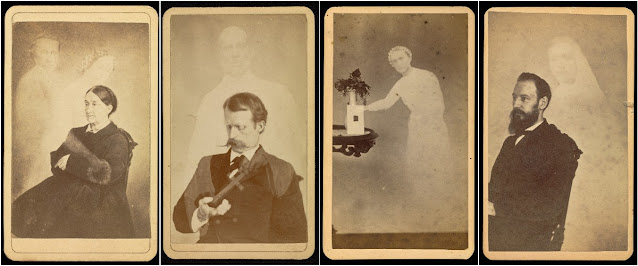
The Spiritualist movement was founded on the belief that the human soul exists beyond the body and that the dead could communicate with the living. This concept developed in the 1850s and gained momentum in the United States after the Civil War. William H. Mumler (1832–1884) claimed to be able to photograph the spirits of departed loved ones. Although his methods were never disclosed, he made ghostly images by incorporating an existing picture of the deceased into a new photograph he made of the surviving relative. His eight-year-long activity was marked by highly publicized civil court trials for fraud.
Before beginning his career as a spirit photographer, Mumler worked as a jewelry engraver in Boston, practicing amateur photography in his spare time. In the early 1860s, he developed a self-portrait that appeared to feature the apparition of his cousin who had been dead for 12 years. This is widely credited as the first spirit photograph—a photograph of a living subject featuring the likeness of a deceased person (often a relative) imprinted by the spirit of the deceased. Mumler then became a full-time spirit photographer, continuing to work in Boston but eventually moving to New York City, where his work was analyzed by numerous photography experts, none of whom could find any evidence of fraud. Spirit photography was a lucrative business thanks to the enormous death tolls that resulted from the American Civil War, and the thousands of families who sought reassurance that their loved ones live on after death.
Critics of Mumler’s work included P. T. Barnum, who claimed that Mumler was taking advantage of people whose judgment was clouded by grief. Barnum’s accusation was one of many in a chorus of voices that had accused Mumler of staging ghosts of people who were still in fact living, and breaking into houses to steal photos of deceased relatives. He was exposed as a fraud when people recognized that some of the supposed spirits were still among the living. Mumler was eventually brought to trial for fraud in April 1869. Barnum testified against him, having hired Abraham Bogardus to create a picture that appeared to show Barnum with the ghost of Abraham Lincoln to demonstrate the ease with which such spirit photographers could be created. Those testifying in support of Mumler included Moses A. Dow, a journalist whom Mumler had photographed. Ultimately Mumler was acquitted because the prosecution could not prove beyond all doubt that he was fabricating the photographs. Following the trial, some sources reported that he was disgraced and died penniless, while others state that his business took off then, due to the publicity of the trial.
Mumler continued working in photography, and later discovered a process by which photo-electrotype plates could be produced and printed as easily as woodcuts (known as the “Mumler Process”). He died on May 16, 1884, and his obituary focused on his photographic contributions in general, making only a passing reference to the earlier spirit photography scandal in the last line. (“The deceased at one time gained considerable notoriety in connection with spirit photographs.”)
Portrait of Robert Bonner with a faint image of a woman behind him.
Photograph of a statuette and drawing on a side table, with a faint image of a woman and baby in the background.
Portrait of a woman sitting in a chair, wearing a dark dress and with her eyes downcase. There is a faint image of a man with his arm raised visible behind her.
Portrait of Col. Cushman with a goatee. There is a faint image of a woman with bobbed hair above him.
Portrait of John J. Glover, with a faint image of an old woman above him.



Leave a Reply