René Bouët-Willaumez (1900–1979) was a French aristocrat born in Brittany, in 1900. After abandoned engineering for art, he began working for Vogue in 1929. Joining the industry in the midst of change, where photography was becoming the dominant means of reporting on fashion trends. This, however, did not hold Willaumez back. His unhesitating and incisive ink drawings illustrated the hubris and elegance of fashion in a way that had not been seen carving out a demand for himself.
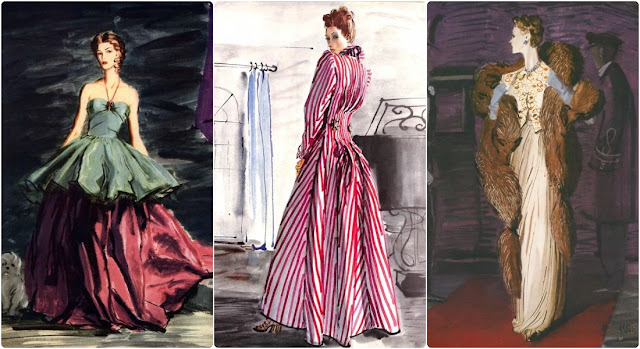
Fashion illustration by René Bouët-Willaumez in the 1930s and ’40s
Within just a few years, Willaumez had honed his craft and his monogram “RBW” became a familiar fixture on the pages and covers of Vogue magazine. By the mid-1930s he was heralded as top of his profession, with his only substantial equal being Carl Erickson.
Willaumez had moved around a lot from Paris to London and then New York. Throughout the 1940s, whilst in New York, the American editor of Vogue made good use of his à la mode style. Willaumez worked with Vogue up until the early 1950s, where his appearance in the magazine abruptly drop. His work last appeared in the American Vogue in 1953. He did contribute to the occasional European edition, but 1958 saw his association with the magazine end. He left New York and returned to France.
Here below is a set of beautiful photos that shows fashion illustration by René Bouët-Willaumez in the 1930s and 1940s.
Gowns by Mainbocher, illustrated by René Bouët-Willaumez, 1934
Illustration by René Bouët-Willaumez, Vogue, 1934
Fashion illustration by René Bouët-Willaumez, Vogue, September 1, 1935
Fashion illustration by René Bouët-Willaumez, Vogue, April 1, 1937.
Fashion illustration by René Bouët-Willaumez, Vogue, April 1, 1937



Leave a Reply