
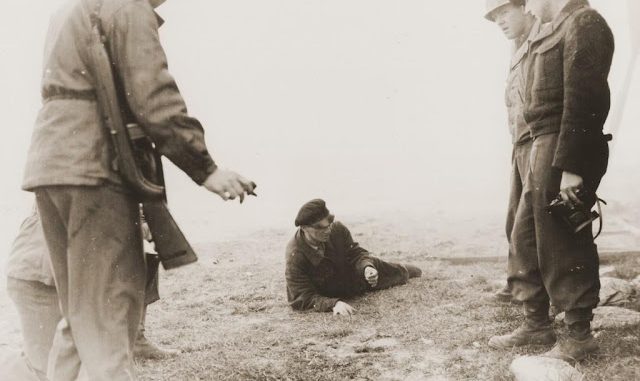
Bonde Gaza, a Hungarian musician who survived the Gardelegen massacre where over 1,000 slave laborers were burnt alive, demonstrates to American soldiers how he managed to escape from the barn which the SS had set on fire. Germany, April 14–18, 1945.

On April 13, 1945, SS troops, joined by local German auxiliary forces, herded 1,016 slave laborers and concentration camp prisoners into a large brick barn on the outskirts of Gardelegen. The prisoners had been forced on grueling death marches from the Mittelbau-Dora and Hannover-Stöcken camps.
The guards lined the floor with gasoline-soaked straw and utilized phosphorus grenades to set the building ablaze. Prisoners who attempted to burrow under the doors or break through the walls to escape the flames and suffocating smoke were systematically machine-gunned by guards waiting outside.
The rapidly advancing U.S. Army reached the site less than 24 hours later on April 14, 1945, catching the perpetrators mid-process as they tried to incinerate and bury the bodies to hide the evidence. Out of more than a thousand prisoners trapped inside, only around 11 to 20 men survived the fire and subsequent executions, with Bonde Gaza being among the few found alive by American liberators.
Deeply shocked by the scene, the U.S. military ordered between 200 and 300 male citizens from the town of Gardelegen to exhume the bodies from mass trenches, recover the remains from the charred barn, and give every victim a proper, individual burial in a newly established memorial cemetery.
Leave a Reply