
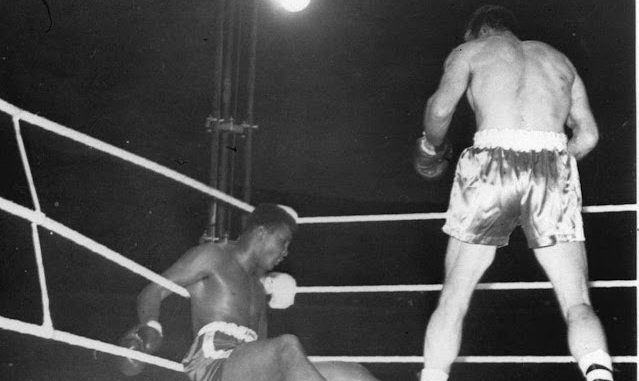
On June 18, 1963, a 21-year-old Cassius Clay (later Muhammad Ali) traveled to Wembley Stadium in London to fight British heavyweight champion Henry Cooper in front of 55,000 fans. It became one of the most famous non-title bouts in boxing history—featuring a dramatic knockdown, tactical controversy, and a precise prediction coming true.
 |
| America’s Cassius Clay is shown sliding against the ropes as he goes down after a wild left hook from British champ Henry Cooper in the fourth round of their bout in London, England, June 18, 1963. |
Clay arrived in London as the brash, undefeated (18–0) top contender, loudly dubbing himself “The Greatest” and declaring that Cooper was a mere stepping stone to world champion Sonny Liston. Playing the ultimate showman, Clay arrived in the ring wearing a crown and delivered his trademark pre-fight prediction: “If he gives me any jive, Cooper will fall in five.”
The 29-year-old Cooper caught Clay off-guard with early aggression, bloodying Clay’s nose in the opening round. Clay rebounded by round two, heavily jabbing Cooper and opening up major cuts on Cooper’s notoriously fragile face. Clay began to taunt Cooper, showboating on the outside.
In the final seconds of the fourth round, Cooper unleashed his trademark, devastating left hook known as ”‘Enry’s ‘Ammer.” The punch landed flush on Clay’s jaw, sending him crashing backward into the canvas. It was the first time Clay had ever been officially floored in his professional career. Clay arose heavily dazed at the count of four just as the bell rang.
The interval between rounds four and five became historic. Realizing Clay was severely disoriented, his trainer, Angelo Dundee, notice a small tear in Clay’s boxing glove. Dundee strategically worsened the tear and informed the referee, buying Clay vital extra seconds to clear his head while handlers looked for a replacement pair. Though debate continues on how much extra time this afforded, it allowed Clay to regain his composure.
Clay emerged for the fifth round with a vengeance. He immediately unleashed a blistering combination that widened the deep gash over Cooper’s left eye. With Cooper bleeding profusely and unable to see, referee Tommy Little stepped in and halted the bout at 2:15 of the fifth round, fulfilling Clay’s exact round-five prediction.
Surviving Cooper’s left hook preserved Clay’s shot at the world title. Just eight months later, in February 1964, Clay shocked the world by defeating Sonny Liston in Miami to become World Heavyweight Champion, after which he changed his name to Muhammad Ali.
Ali and Cooper met again in a 1966 rematch at Highbury Stadium, where Ali once again won on cuts in Round 6. Cooper remained one of the few men Ali openly praised for having legitimate knockout power.
 |
| Boxer Cassius Clay rests during an early morning run in London’s Hyde Park. Clay is preparing for his fight at Wembley with British heavyweight Henry Cooper. |


 |
| Muhammad Ali during a training session at the Territorial Army Centre in White City, London, before his fight with Henry Cooper. |
 |
| Cassius Clay shakes hands with Henry Cooper during the weigh-in at London Palladium. Clay continued his confident boastings that he will beat Cooper in five rounds in their fight at Wembley Stadium tonight. |
Leave a Reply