Mug shots are photographic portraits of arrested suspects and convicted criminals. Since the mid-19th century, they have been used to help form a record of identification for the police. However, they are far from being mundane bits of police paperwork. Rather, mug shots are intriguing images which have a powerful ability to captivate our imaginations. Perhaps this is because of the interesting questions they evoke: What crime did this person commit? Were they guilty? Do they look like a criminal? Do they look normal? What happened to them?
Using the New Zealand Police Museum’s collection of mug shots from the 19th century, this exhibition will start to answer some of these questions, and explore the stories behind these compelling photographs. From the people in the images, to the history of mug shots, to the role of criminal identification in New Zealand Police, these mug shots can provide a window to many fascinating stories of the past.
The New Zealand Police Force was officially established on September 1, 1886, and they began collecting photographs of prisoners that same year. These first photographs look a little different from modern mug shots. This is largely because there were no officially trained police photographers in New Zealand at the time. Instead, the police relied on commercial photographers and amateur camera enthusiasts to take the mug shots. Because of this, the style of early mug shots in the collection of the New Zealand Police Museum vary greatly from photograph to photograph.
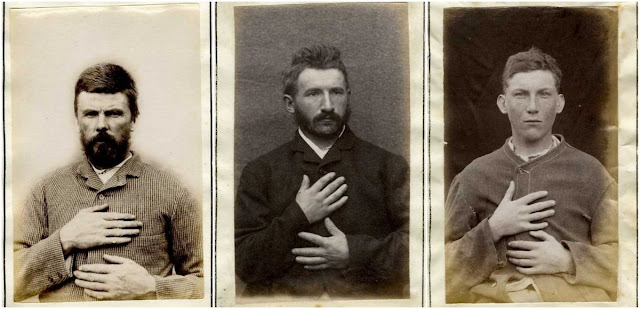
One common element in many mug shots, however, is the display of prisoners’ hands. In 1886, the introduction of fingerprinting in New Zealand was still nearly two decades away, so the inclusion of hands in mug shots provided an additional point of identification for police. Missing fingers, scars, and the general shape and condition of the prisoners’ hands could all help in the identification of a suspect.
Here, these images below show a few examples of prisoners with distinctive hands from the 19th century:
Ah Chop (b. 1854, China). Charged with attempted larceny and sentenced to 2 years in gaol on April 9, 1889 (Invercargill). A miner by trade, he is described as being a pagan by religion with a sallow complexion. Photograph taken on June 15, 1889.
Alex Haddlestone alias Fiddlestone/Thomas Edwards/Edmunds/Allan (b. 1861, New Zealand). Charged with larceny and sentenced to 18 months in gaol on October 24, 1886 (Blenheim). Previous charges for larceny and false pretences. Photograph taken on August 18, 1886.
Alfred Hyde (b. 1836, Denmark). Charged with forgery & uttering and sentenced to 3 years in gaol on January 7, 1886 (Auckland). A draughtsman by trade. Photograph taken on April 13, 1886.
Alfred Langley (b. 1837, England). Charged with illegal gaming and sentenced to 1 month in gaol on March 20, 1889 (Christchurch). Described as having a mole on his left knee. Photograph taken on April 19, 1887.
Alick Evan McGregor (b. 1869, India). Charged with larceny and sentenced to 1 month in gaol on April 15, 1887 (Hastings). Describe as a “notorious young thief” with a “freckled face.” Photograph taken on May 5, 1887.



Leave a Reply