Dead bodies line the streets of Calcutta shortly after the Bengal famine. On the rooftops overhead, vultures swoop in.
Calcutta, India. 1946.Saktishree DM/Flickr
2 of 36
A starving child begs for food.
Calcutta, India. December 17, 1943.Bettmann/Getty Images
3 of 36
Villagers walk by an old woman, dying on the side of the road,. They barely even notice — it is too common a sight.
Bengal, India. 1943.William Vandivert/The LIFE Picture Collection/Getty Images
4 of 36
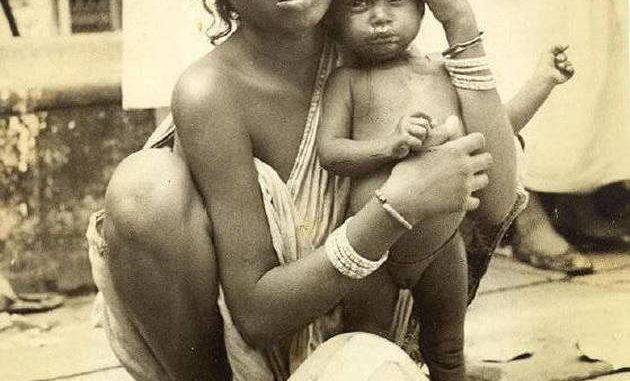
A girl married too young stands on the streets with her infant child, struggling to get enough food for both of them out of a single coconut.
Calcutta, India. Circa 1945.Clyde Waddell/Penn Library Collections
5 of 36
Starving people gather out in droves, waiting for government aid.
Bengal, India. 1943.Keystone-Mast Collection, UCR/California Museum of Photography, University of California, Riverside
6 of 36
Gandhi addresses a crowd, pleading with them to stay calm.
Bengal, India. Circa 1944-1946.Saktishree DM / Flickr
7 of 36
A hungry child drinks from a bowl.
Bengal, India. 1943.Wikimedia Commons
8 of 36
A mother and her child, struggling through the famine.
The photographer, Kalyani Bhattacharjee, sent this photo to England with this disclaimer: “Out of 300 photos that were at our disposal we have selected only 50 that were somewhat presentable to the public eyes. To make them look less gruesome, we have got them decorated with relief drawings in pleasant light colours.”
Bengal, India. 1944.Wikimedia Commons
9 of 36
A child infected with smallpox.
The most devastating part of the famine was the influx of disease. Smallpox, cholera, and dysentery wiped out people in droves. With too little food to keep their strength up, there was little they could do to fight off the disease.
Bengal, India. 1943.Wikimedia Commons
10 of 36
Devout Hindu Brahmins gather to pray.
Calcutta, India. Circa 1945.Clyde Waddell/Penn Library Collections
11 of 36
Burmese refugees flee into India after the Japanese invasion.
The influx of refugees, the loss of food supplies from Burma, and the new-found focus of Japanese bombers would be some of the biggest causes of the Bengal famine.
Burmese-Indian Border. January 31, 1942.Wikimedia Commons
12 of 36
A starving family sits by the doorway.
Bengal, India. 1943.Wikimedia Commons
13 of 36
A woman struggles to nurse a starving man back to health.
Bengal, India. 1943.Wikimedia Commons
14 of 36
The outline of an old man’s ribs poke out through his bare chest.
Bengal, India. 1943.William Vandivert/The LIFE Picture Collection/Getty Images
15 of 36
Emaciated people chase away the pain in an opium den in Calcutta’s Chinatown.
Calcutta, India. Circa 1945.Clyde Waddell/Penn Library Collections
16 of 36
An American soldier, arriving shortly after the height of the famine ended, picks out a prostitute.
Though the soldier is unaware, these women have turned to prostitution out of desperate starvation because of the famine. They are asking for $3 for a night — enough money to eat.
Calcutta, India. Circa 1945.Clyde Waddell/Penn Library Collections
17 of 36
An emaciated, starving woman sits on the curb, barely strong enough to move.
Calcutta, India. December 17, 1943.Bettmann/Getty Images
18 of 36
A group of devout Hindu monks during the Bengal famine.
Bengal, India. 1943.Keystone-Mast Collection, UCR/California Museum of Photography, University of California, Riverside
19 of 36
A child and his dog lie on the street, starving.
Bengal, India. 1943.Wikimedia Commons
20 of 36
The dead body of an old man, starved to death, lies on the streets of Calcutta.
Calcutta, India. December 17, 1943.Bettmann/Getty Images
21 of 36
Truck sweepers clean the corpses off of the streets.
Calcutta, India. 1943.William Vandivert/The LIFE Picture Collection/Getty Images
22 of 36
Indian men cremate the starved dead that fill their streets.
Bengal, India. 1943.William Vandivert/The LIFE Picture Collection/Getty Images
23 of 36
Under these mats are the bodies of the unknown dead; those who died without a soul to remember their names. Soon, the mats — and the bodies below them — will be burned.
Bengal, India. 1943.William Vandivert/The LIFE Picture Collection/Getty Images
24 of 36
More than 50,000 starving people come out to beg for relief from the Bengal famine.
Bengal, India. 1943.Keystone-Mast Collection, UCR/California Museum of Photography, University of California, Riverside
25 of 36
A doctor treats a diseased patient on the streets.
Bengal, India. 1943.Keystone-Mast Collection, UCR/California Museum of Photography, University of California, Riverside
26 of 36
A starving, bed-ridden man.
Bengal, India. 1943.Keystone-Mast Collection, UCR/California Museum of Photography, University of California, Riverside
27 of 36
Homeless men in Calcutta gather together in a mass, struggling to keep warm through the night.
Calcutta, India. Circa 1945.Clyde Waddell / Penn Library Collections
28 of 36
Government relief comes in to feed the starving people of India.
Bengal, India. 1943.Keystone-Mast Collection, UCR/California Museum of Photography, University of California, Riverside
29 of 36
Relief workers feed an emaciated man.
Bengal, India. 1943.Keystone-Mast Collection, UCR/California Museum of Photography, University of California, Riverside
30 of 36
Relief workers struggle to feed the starving people in Bengal.
Bengal, India. 1943.Keystone-Mast Collection, UCR/California Museum of Photography, University of California, Riverside
31 of 36
After a deadly riot breaks out, bodies litter the streets of Calcutta.
Calcutta, India. 1946.Wikimedia Commons
32 of 36
Workers struggle to spread enough kindling to cremate all of the dead.
Bengal, India. Circa 1943-1946.Saktishree DM / Flickr
33 of 36
Refugees flee India and the death and destruction behind them.
Bengal, India. Circa 1943 – 1946.Saktishree DM / Flickr
34 of 36
A Hindu man comes out to burn his dead. The small bundle before him is the lifeless body of an infant child.
Calcutta, India. Circa 1945.Clyde Waddell / Penn Library Collections
35 of 36
A starving woman lies dying on the streets.
This picture was taken after the famine had officially ended. Its impact still lingers on. As the original caption notes: “During the famine of 1943, cases like this were to be seen in most every block, and though less frequent now, the hardened public reaction seems to have endured.”
Calcutta, India. Circa 1945.Clyde Waddell / Penn Library Collections
36 of 36
Like this gallery? Share it:
Photos Of The Forgotten Bengal Famine Fueled By British Colonialism
View Gallery
Though few in the West likely know its name, the Bengal Famine was one of the greatest massacres of World War II — and it wasn’t even caused by India’s enemies. It was brought on by British policies that put the lives of soldiers over Indian civilians and it killed an estimated 3 million people. By the time the famine was over, it killed more citizens of the British Empire than the Axis ever would.
Even before the war, the people of Bengal, India had already been struggling with a small food supply and a skyrocketing population. By 1930, the area had the least nutritious diet in the world, and the battering of tropical storms wasn’t making it any better.
But the war made things far worse. Life in Bengal became a horror show after Japan invaded Burma. Burmese refugees fled into India for shelter, and Japanese bombing raids followed on their heels. Fields were destroyed, the population grew, and what little food the people of Bengal had was stretched even further.
So, they called their colonial overlords in Britain for help — but they only made it worse. First, they moved the army out to Bengal, on the eastern side of India, to defend the border. But these soldiers had to be fed — and the British government ordered that the army get priority food distribution. Food went to the soldiers, and civilians were left to starve.
Then, the British started a scorched-earth project, destroying food supplies and transports in Bengal and even confiscating civilians boats out of fear that the Japanese might steal these things from them.
The other provinces of India, in a panic, started refusing to trade with each other. Food shipments to Bengal stopped and the people of Eastern India were left with no way to get help from their countrymen.
Without enough food to feed everybody, the price of rice skyrocketed. People starved on the streets, and diseases like cholera, malaria, smallpox, and dysentery devastated their malnourished bodies.
The stories that came out of the Bengal famine are horrific. One witness described seeing children, driven to desperation from starvation, “picking and eating undigested grains out of a beggars’ diarrheal discharge.” Another saw a man fall dead after getting slapped for stealing food. “In those days,” the witness said, “everyone was so weak a slap could kill you.”
By the end, so many died that no one could keep count of the dead. By some accounts, it was 1.5 million, by others, 3 million. But no matter which number you believe, more citizens of the British Empire died in the Bengal Famine than in all of World War II combined.


Leave a Reply