
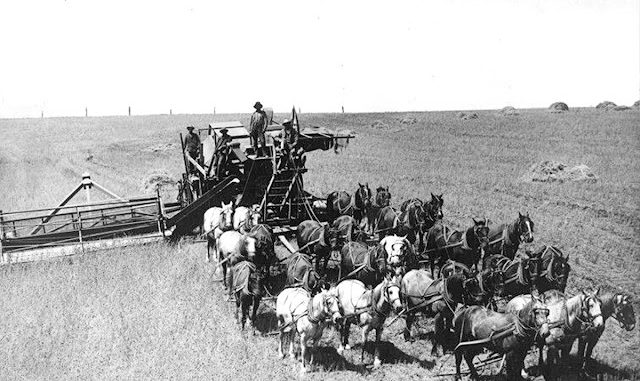
During the late 19th and early 20th centuries, horse-drawn combine harvesters reached their absolute peak of scale and complexity, transforming vast agricultural landscapes like the American West and Pacific Northwest. Facing a major rural labor shortage after the California Gold Rush, manufacturers pushed mechanical boundaries to engineer giant, wooden “pull-type” behemoths that relied entirely on massive teams of animals for power.
During this period, the size of combine harvesters grew rapidly to maximize efficiency in the vast wheat fields of California, Oregon, and Washington State. To move these multi-ton wooden machines, farmers used immense teams typically ranging from 20 to 40 horses or mules. A legendary and frequently photographed standard was the 33-horse hitch, often configured in lines of up to 12 animals abreast.
Operating the hitch was an art form. The “skinner” (driver) sat on a high perch at the front of the combine, managing dozens of leather reins and utilizing specialized verbal commands to orchestrate the movement of the entire herd. Each horse wore custom collars and had a strictly designated position in the hierarchy. A single massive machine could cut and thresh 40 to 50 acres of wheat a day, effectively replacing the grueling physical labor of 60 to 100 men using hand scythes.
The late 19th century introduced crucial technological changes that transitioned combines from experimental novelties into reliable industrial assets. In 1886, the Holt Manufacturing Company introduced a landmark design utilizing link belting and sprockets instead of rigid iron gears. This was a massive safety breakthrough: if a team of horses suddenly panicked or ran away, the flexible link belts would snap cleanly rather than stripping the expensive internal gears of the harvester.
Harvesting the rolling, steep terrain of the Palouse region in Washington State was incredibly dangerous; a normal combine would tip over or spill its grain screens. Holt patented the “sidehill combine,” featuring a pivoting chassis. Operators could manually adjust the leveling mechanism, keeping the internal threshing equipment perfectly horizontal while the outer wheels tracked along steep inclines.
Running a late-19th-century harvest required an army of support staff working alongside the horses. Beyond the main driver, a typical team included a separator man (mechanic) to grease the bearings and monitor the belts, and multiple sack-sewers who caught the cleaned grain, sewed the burlap sacks shut, and dropped them onto a side ramp. The horses required relentless care. Supply wagons followed the harvesters strictly to provide water and feed to the team during midday breaks. Because of the extreme physical toll, horses had to be rotated to prevent exhaustion.
By the early 1910s, the limits of animal logistics became glaringly clear. Feeding, housing, and harnessing 30+ horses every morning required too much time and overhead. The transition away from animal power happened in distinct waves. Farmers began mounting small gasoline engines directly onto the horse-drawn combines to spin the internal threshing parts. This meant the horses only had to pull the dead weight of the machine, narrowing the team size down significantly.
By the 1920s, heavy internal combustion tractors, including early crawler tractors developed by companies like Caterpillar (which bought out Holt), fully replaced animal teams. By the late 1930s, the final commercial horse-drawn combines were retired, ending one of the most visually spectacular eras in agricultural history.


Leave a Reply