
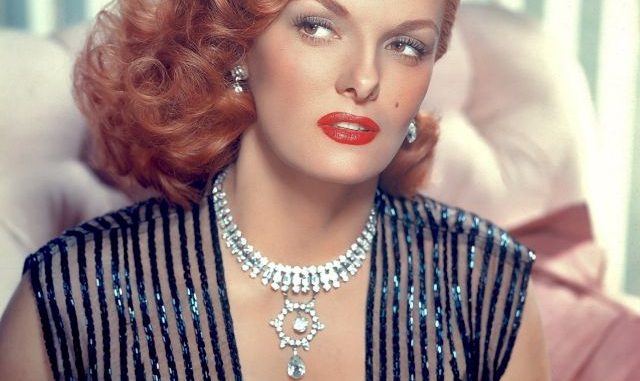
In the 1950s, Jane Russell (June 21, 1921 – February 28, 2011) was at the absolute peak of her stardom, evolving from a controversial 1940s bombshell into one of Hollywood’s most bankable, charismatic, and multi-talented leading ladies. While her early career was defined by the sheer hype of her debut in The Outlaw (which fought censors for years), the 1950s allowed her to showcase her sharp comedic timing, robust singing voice, and genuine screen presence.
Though Marilyn Monroe often dominates the modern memory of the technicolor masterpiece Gentlemen Prefer Blondes (1953), Russell was actually the top-billed star at the time, and she was paid significantly more ($200,000 compared to Monroe’s $18,000). Russell played Dorothy Shaw, the sharp-witted, grounded brunette foil to Monroe’s naive Lorelei Lee. Contrary to the tabloid rumors of a bitter rivalry, Russell and Monroe got along famously. Russell often protected the notoriously anxious Monroe on set, helping her out of her dressing room when stage fright struck.
Russell spent much of the 1950s under contract to eccentric billionaire Howard Hughes (via RKO Pictures), who was obsessed with her image. However, Russell herself had a brilliant, down-to-earth sense of humor that subverted the passive sex-symbol trope. She often played women who were witty, fiercely independent, and completely unfazed by alpha males. She held her own against the toughest leading men of the era, starring alongside Robert Mitchum in the gritty noirs His Kind of Woman (1951) and Macao (1952), and Clark Gable in the Western The Tall Men (1955).
Russell wasn’t just a film actress; she utilized her deep, sultry contralto voice extensively throughout the decade. Beyond Blondes, she starred in musical comedies like Double Dynamite (1951) with Frank Sinatra and Groucho Marx, and The French Line (1953).
The 1950s cemented Russell as a pop-culture icon of industrial proportions. Howard Hughes famously used his structural engineering background to design a seamless, cantilevered underwire bra specifically to emphasize her bust during The Outlaw. Though Russell later admitted she secretly discarded the uncomfortable contraption and just used her own clever padding, the “Jane Russell bra” became a cultural fixture of 1950s Americana, eventually leading her to become a famous spokesperson for Playtex bras in later decades.


Leave a Reply