
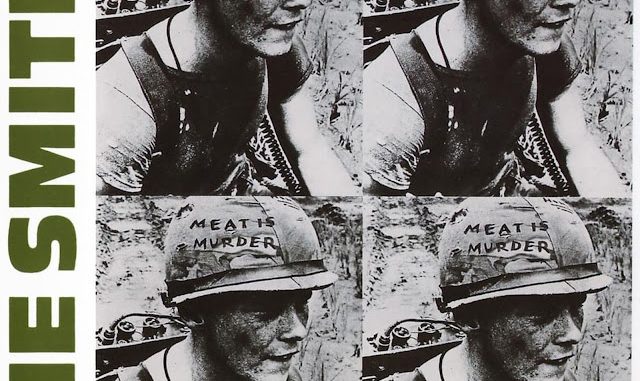
Meat Is Murder is the second studio album by the Smiths, released on 11 February 1985 by Rough Trade Records. Following the release of their self-titled debut album in early 1984, the Smiths maintained a prolific output with non-album singles and the compilation Hatful of Hollow, while also drawing media attention for their outspoken political views and provocative lyrics.
The Smiths’ 1985 album cover features an altered photograph of a 20-year-old American Marine Corporal named Michael Wynn. Taken on September 21, 1967, during the Vietnam War.
 |
The photograph originally appeared as promotional still and archival footage in the 1968 Oscar-nominated anti-war documentary, In the Year of the Pig, directed by American filmmaker Emile de Antonio. Frontman Morrissey, who curated most of the band’s distinctive record covers, intercepted this striking visual for the band’s second album sleeve.
In the authentic photo, Wynn had handwritten the popular counter-culture slogan “Make War Not Love” across his M1 helmet. Morrissey and layout designer Caryn Gough systematically doctored the image, superimposing the message “Meat Is Murder” over the original text to align with the LP’s fierce pro-vegetarian title track.
 |
| The original un-altered photograph of Michael Wynn. |
According to Morrissey, the jarring parallel between military slaughter and the commercial meat industry was entirely deliberate. He intended the provocative image to serve as a harsh wake-up call, stating that the only way to challenge institutionalized cruelty was to give society “a taste of their own medicine.”
Michael Wynn survived the Vietnam War and later immigrated to Australia in 1982, completely unaware of his global indie-rock fame. The Smiths never sought permission to use or alter his likeness. Wynn only discovered he was a legendary album cover star in 1985 when his sister spotted the vinyl record sitting on a shop shelf.
Wynn publicly expressed that he was initially unhappy about the band modifying his helmet’s original text. Decades later, music critics and historians noted an unintended poetry to the image: many Vietnam veterans returned home traumatized by PTSD only to face public ridicule, frequently feeling as though they had been treated like literal pieces of meat by the military apparatus and the public alike.
Leave a Reply