
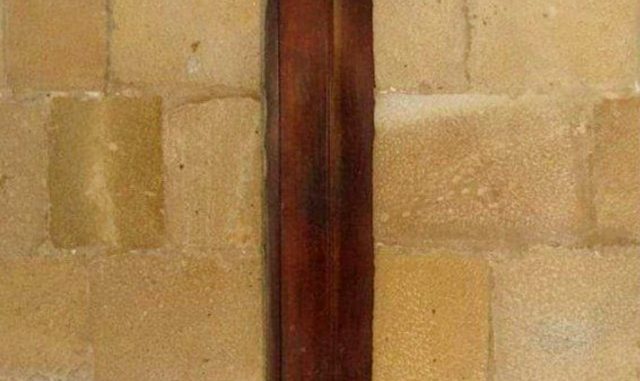
The famously narrow door at the Alcobaça Monastery (Mosteiro de Santa Maria de Alcobaça) in Portugal is one of the most curious architectural features of the medieval world. Locally known as the Porta Pega-Gordos (literally the “Fat-Catcher Door” or “Anti-Gluttony Door’), it stands as a stark, physical reminder of medieval monastic discipline.

The Monastery of Alcobaça, a UNESCO World Heritage Site, was founded in 1153 by Portugal’s first king, Afonso Henriques (Afonso I), and given to the Cistercian Order. It is one of the largest and most important medieval Cistercian monasteries in Europe, known for its Gothic architecture, austere design reflecting Cistercian values of simplicity, manual labor, and discipline, and its historical ties to the Portuguese monarchy.
The refectory (dining hall) is a large Gothic room with rib vaulting where monks ate in silence while one read aloud from the Bible (from a notable embedded pulpit). Adjacent to it was the kitchen.
According to the widespread story, the door between the kitchen and refectory was deliberately built very narrow (often cited as ~32 cm / ~12.5 inches wide and quite tall). Monks had to pass through it to fetch their own meals. If a monk had become too overweight to fit (due to gluttony, one of the seven deadly sins), he was forced to fast until he could squeeze through again. This enforced discipline, humility, and adherence to vows of poverty and temperance in an era when monasteries could have abundant food from their lands.
This is largely a modern myth or folk legend, not supported by strong historical evidence. The doorway is approximately 50 cm (about 1.6 feet) wide, narrow but wide enough for most people to pass comfortably, and certainly not a strict “squeeze test.”
It was most likely a serving hatch (an early version of a pass-through window) for handing plates, dishes, and food from the kitchen to the refectory. The official monastery visitor guide refers to it as the “dish-carrier” door used for passing food.
A true anti-gluttony door would be highly inconvenient for daily operations. There is a wider regular door nearby. Cistercian monks followed a generally modest diet, and constructing a special architectural feature just for rare cases of overeating makes little sense. No contemporary medieval records confirm the gluttony-enforcement use.

The story appears to have gained traction in recent decades, possibly popularized by tour guides for entertainment. The monastery itself acknowledges the legend but clarifies the practical serving purpose.
It’s a memorable, humorous anecdote that embodies stereotypes about medieval monks and the strictness of monastic life. Similar “anti-gluttony” stories exist for other sites, but evidence is thin across the board. The door remains a fun photo spot for visitors today.
 |
| Façade of the Monastery of Alcobaça. The portal and rose window of the church are original Gothic (early 13th century), while the towers are Baroque (18th century). |
Leave a Reply