
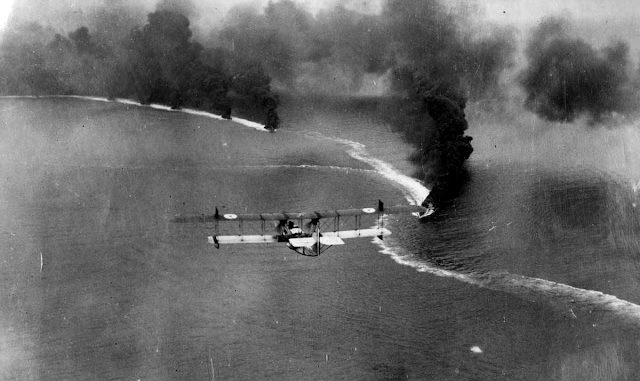
This amazing vintage footage from 1923 shows how early 20th century technology could make a battleship blind to an oncoming aerial attack. The video shows a biplane soaring over warships of the U.S. Navy and creating an instantaneous wall of smoke large enough to hide a fleet behind.
One of the most popular tactics for early steam navy forces was the newfound ability to make instant smokescreens, either by ordering the stokers to burn cheap coal in designated boilers; constricting the airflow to the boilers and thus creating billows due to the choking flame; or by adding oil to the coal or funnel. This common tactic was a hit by the turn of the century, with Edwardian/Great White Fleet era ships– destroyers in particular– practicing it regularly.
By the end of the Great War, aircraft delivered smoke screens had been added to the lexicon as had purpose-made smoke generating devices.
This opaque white chemical smoke (titanium tetrachloride) was generally more effective than the sooty black boiler smoke of the Great War age, which tended to dissipate rather quickly. By the 1930s, the U.S. Navy used three different recipes for smoke: HC or hexachloroethane type smoke mixture, FS, or sulfur trioxide in chlorosulfonic acid, FM, or titanium tetrachloride, and WP or white phosphorus.
Today’s technology has rendered smoke obsolete, however. Most forms of radar and infrared sensors can see straight through conventional smoke, though how imaging infrared cameras would perceive a titanium tetrachloride smokescreen is unknown.
In addition, the ability of aircraft to launch radar-guided anti-ship cruise missiles fifty or more miles away from their targets makes smokescreens irrelevant. Instead, warplanes of today use speed, low altitude flying, electronic warfare jamming and stealth technology to sneak up on enemy warships. It’s definitely more environmentally friendly than curtains of titanium acid.
 |
| American destroyers lay down a smokescreen during maneuvers on the West Coast, 1926. |
 |
| A Curtis H-16 flying boat lays a smoke screen near units of the U.S. Fleet at anchor near Panama, circa 1924. |
 |
| Aircraft lay a smokescreen over USS Langley (CV-1) during fleet maneuvers in 1930. |
 |
| USS Lexington (CV-2) Steams through an aircraft-deployed smoke screen, February 26, 1929, shortly after that year’s Fleet Problem exercises. |
 |
| Smoke Screen is laid by three T4M-type torpedo bombers, circa early 1930s. |
Leave a Reply