
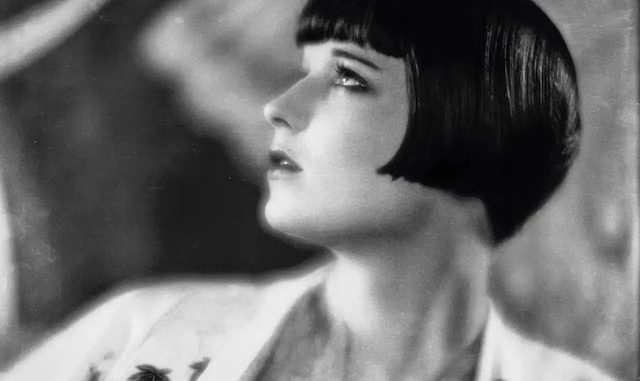
Louise Brooks (1906–1985), the iconic silent-film actress and dancer known for popularizing the sharp bob haircut, was extensively photographed by Paramount’s chief portrait photographer Eugene Robert Richee (1896–1972) during the mid-to-late 1920s. These sessions produced some of the most enduring images of the Jazz Age and Roaring Twenties, especially a celebrated 1928 series in which Brooks appears in a black dress against a black background, holding a long strand of pearls.
Born Mary Louise Brooks on November 14, 1906, in Cherryvale, Kansas, she left home at 15 to study modern dance with Ruth St. Denis and Ted Shawn’s Denishawn company. She later danced in George White’s Scandals and the Ziegfeld Follies, which brought her to the attention of Paramount producer Walter Wanger. She signed a five-year contract with the studio in 1925 and began appearing in films, first in supporting roles and then as a lead in light comedies and flapper pictures.
By the late 1920s she had appeared in roughly a dozen films, including The American Venus (1926), It’s the Old Army Game (1926), A Girl in Every Port (1928), and Beggars of Life (1928). Her distinctive look with sleek black bob, pale skin, and intense dark eyes made her a natural for glamorous publicity stills and a symbol of the modern, independent “flapper.” She was also known for her intelligence, independence, and sometimes difficult relationship with the Hollywood studio system. In 1929 she left Paramount and went to Europe, where she starred for G.W. Pabst in Pandora’s Box and Diary of a Lost Girl, roles that cemented her lasting legend even as her American career faded.
Richee was born August 21, 1896, in Denver, Colorado. He entered Paramount’s photography department in the early 1920s, initially assisting Donald Biddle Keyes, and later headed the studio’s portrait gallery for roughly two decades. He photographed many of Paramount’s major stars of the era using large-format 8×10 cameras. His style emphasized careful lighting, soft diffusion in some work, and strong graphic composition; he sometimes used reflective props for added glamour. He later worked at Warner Bros. and elsewhere and died in 1972. Biographical details about him remain relatively sparse compared with better-known Hollywood portraitists such as George Hurrell.
Richee photographed Brooks repeatedly from about 1925 to the early 1930s (with the densest work during her Paramount years). Studio portrait sessions were standard publicity practice: stars posed in costumes, fashion, or idealized glamour setups that were then distributed to magazines, newspapers, and theaters. Brooks was considered one of the era’s most photogenic subjects, and Richee’s images of her are widely regarded as among his finest and the definitive visual record of her 1920s screen persona.
The most famous session is the 1928 “pearls” series. In the best-known frame, Brooks stands in profile in a long-sleeved black dress against a seamless black background; only her face, hands, and the long string of pearls are illuminated. The high-contrast, minimalist composition isolates her sharp bob (which curves across her cheek) and the elegant curve of the necklace. Retouching of the negative enhanced the pure black surround. Contemporary commentators note that the image perfectly captures the graphic, modern spirit of 1920s fashion and design; the bob itself became one of the century’s most influential hairstyles.
Richee also made more conventional portraits and fashion stills of Brooks, often in elegant interiors or against painted backdrops. Brooks later recalled their working relationship with characteristic brevity: “Eugene Richee used to take 60 shots in two hours. We never said a word to each other. Perfect relationship.”
These photographs outlived the short commercial peak of Brooks’s Hollywood career. They helped fix her image in popular memory as the quintessential flapper and silent-screen siren, and they remain among the most reproduced and admired Hollywood portraits of the decade. Richee’s contribution is frequently singled out as especially successful in capturing her distinctive look and presence.


Leave a Reply