
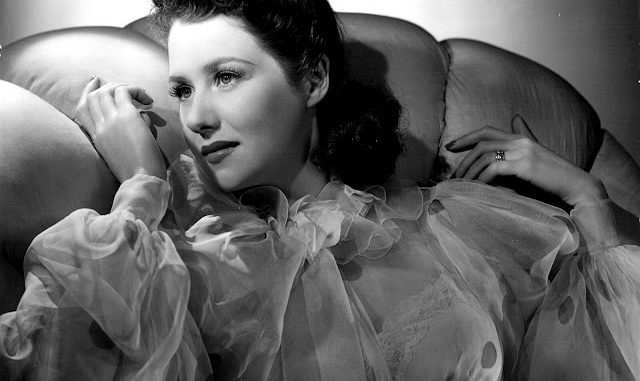
Ruth Warrick (June 29, 1916 – January 15, 2005) had a fascinating, high-profile entry into Hollywood in the 1940s, transitioning from a radio singer and actress to a prominent film star. Her decade was defined by working with legendary directors, portraying strong (and often complex) women, and establishing herself as a versatile talent.
Warrick’s career changed overnight when Orson Welles cast her as Emily Monroe Norton Kane, the first wife of Charles Foster Kane, in Citizen Kane. Welles reportedly chose her because she possessed the refinement and elegance he envisioned for the role, famously saying he wanted “an actress who is a lady.” The film is now widely regarded as one of the greatest ever made, and Warrick’s performance, especially during the famous breakfast-table montage, remains one of its highlights.
Following the success of Citizen Kane, Warrick signed with RKO and became a sought-after leading lady, frequently playing sophisticated, dignified, or quietly resilient characters.
In 1943, she starred in the espionage thriller Journey into Fear, which featured Orson Welles and several other alumni. She showcased her range in films like The Iron Major (1943), a biographical sports drama opposite Pat O’Brien, and Blood on the Moon (1948), a gritty psychological Western starring Robert Mitchum, where she played the crucial role of Amy Lufton.
Warrick’s 1940s filmography is notable for the caliber of directors she worked with beyond Welles. She starred in A Scandal in Paris (1946), a biographical film about the French criminal-turned-detective Eugène François Vidocq, working under Sirk’s distinctively elegant direction. She closed out the decade working with Capra in this musical comedy Riding High (1950, filmed in late 1949) alongside Bing Crosby.
In 1946, Warrick took on the live-action role of Sally, the protective and traditional mother of young Johnny, in Walt Disney’s musically iconic but historically controversial Song of the South. While the film itself later became locked in the Disney vaults due to its depiction of the post-Civil War South, it was a massive box-office property at the time and a major credit in her mid-40s portfolio.
As the 1940s came to a close, the landscape of entertainment began to shift. Warrick, with her deep background in live radio, adapted seamlessly to the birth of broadcast television. By the late 1940s and early 1950s, she began appearing in anthology drama series, paving the way for the soap opera stardom (most famously as Phoebe Tyler Wallingford on All My Children) that would define the later chapters of her long career.


Leave a Reply