
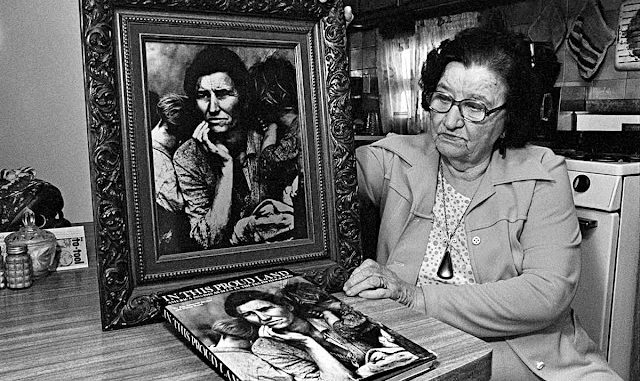
Florence Owens Thompson, the “Migrant Mother” in Dorothea Lange’s world-famous 1936 photo, holds up her likeness during an interview after her identity was made known on October 10, 1978.

In March 1936, photographer Dorothea Lange was working for the U.S. government’s Resettlement Administration (later the Farm Security Administration) to document rural poverty. While driving past a migrant pea-pickers’ camp in Nipomo, California, Lange turned her car around and encountered Thompson.
Thompson, then a 32-year-old mother of seven of Cherokee descent, was stranded at the camp after her family’s car broke down. Lange took a series of frames in a span of just 10 minutes. The final frame, showing a worried Thompson staring into the distance while her children shield their faces, became known as “Migrant Mother.”
 |
| Migrant Mother, taken by Dorothea Lange in 1936. |
After the photo was published in a San Francisco newspaper, the public outcry prompted the federal government to immediately rush 20,000 pounds of food to the starving pea-pickers’ camp.
Because Lange was working as a government employee, the photo went directly into the public domain. Lange never asked for Thompson’s name, and Thompson never received a single cent in royalties or compensation, even as the photo became a globally recognized masterpiece printed in textbook after textbook.
For over 40 years, the public had no idea who the “Migrant Mother” actually was. Meanwhile, Thompson worked multiple jobs (picking cotton, waitressing, and working in a cannery) to raise her children.
In 1978, a reporter from The Modesto Bee tracked her down to her mobile home in Modesto, California. This specific image was captured during that revelation. Thompson expressed bitter resentment toward the photograph, stating:
“I wish she [Lange] hadn’t taken my picture. I can’t get a penny out of it. She didn’t ask my name. She said she wouldn’t sell the pictures. She said she’d send me a copy. She never did.”
While Thompson initially viewed the photo as a curse that froze her in her lowest moment of poverty, her children felt differently. They grew to be immensely proud of their mother, viewing the image as a monumental tribute to her resilience and the strength of a mother who sacrificed everything to keep her children alive.
 |
| Thompson (seated) with three of her daughters (from L. to R.), Katherine, Ruby and Norma, in 1979; 43 years after Migrant Mother. |
In August 1983, Thompson suffered a stroke and was diagnosed with cancer, leaving her family with staggering medical bills they could not afford. Her children leveraged her late-in-life fame and issued a public appeal.
Recognizing the woman who had humanized the Great Depression for generations, the American public sent in over $110,000 in donations to cover her medical care. Thompson passed away a month later in September 1983 at the age of 80.


Leave a Reply