
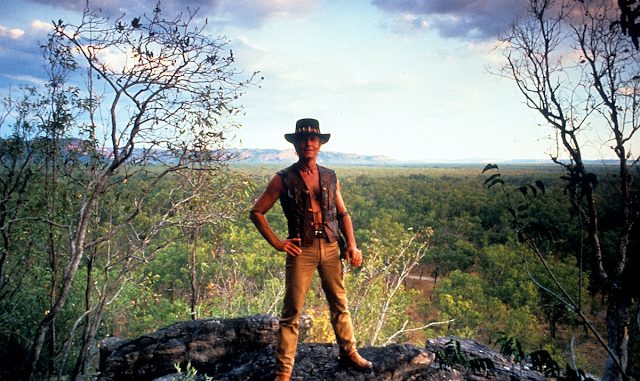
On the set of the 1986 global phenomenon Crocodile Dundee, Paul Hogan approached filmmaking with the same laid-back, practical, and highly improvisational attitude that defined his iconic character, Mick Dundee. Hogan, who co-wrote the screenplay and developed the story, was a massively popular TV comic in Australia at the time but a first-time feature filmmaker.
One of the film’s most famous Outback scenes, where Mick Dundee tames a wild water buffalo with a hypnotic hand gesture, was built on Hogan’s quick thinking. The production crew had administered a mild tranquilizer to the animal to make it lie down. When the buffalo’s legs began to give way unevenly, Hogan improvised his iconic hand gesture on the spot, and director Peter Faiman kept the take.
Filming on location in Australia’s rugged Northern Territory and Manhattan, Hogan and his producer partner, John Cornell, deliberately engineered the movie to cross over into mainstream American markets. Despite the highly targeted strategy, Hogan admitted during 1986 promotions that he drastically underestimated its eventual $328 million international success.
Hogan’s old-school, practical mindset extended far beyond the camera. Unprepared for the sudden, massive multi-million-dollar explosion at the American box office and deeply skeptical of the Hollywood financial system, Hogan eschewed high-powered accountants. Instead, he took total control by literally packing tens of thousands of dollars of his cash earnings into envelopes, luggage, and rolled-up socks while flying between Sydney and Los Angeles.


Leave a Reply