
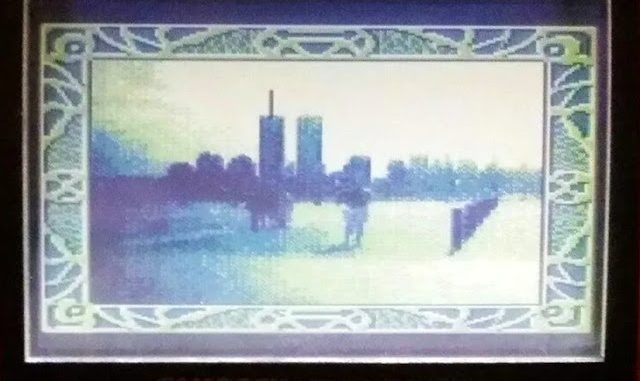
This image of the iconic Twin Towers was taken from a street-level perspective, rendered in the unmistakable 4-color grayscale palette (2-bit) and ultra-low 128×112 pixel resolution characteristic of Nintendo’s 1998 Game Boy Camera accessory. It was captured in July 2001, exactly two months before the September 11 attacks, by an anonymous visitor who brought their handheld console to the plaza.

While it looks like a modern digital filter or pixel art recreation, the image is completely real. It belongs to a rare category of pre-9/11 photography where hobbyists documented New York City using primitive digital tech. Similar projects from that exact era, such as photographer David Friedman’s 2000–2001 Game Boy Camera New York series, have been archived online to preserve how the turn-of-the-century skyline looked through the lens of a literal toy.
The Game Boy Camera (released as the Pocket Camera in Japan) is one of the most eccentric and historically significant peripherals in gaming history. Launched by Nintendo in 1998 for $49.95, it handed an entire generation of kids and tech enthusiasts their very first taste of consumer digital photography.

When it debuted, Nintendo marketed the cartridge strictly as a toy. However, it was a massive technological achievement under the hood. In the 1999 Guinness Book of World Records, the Game Boy Camera was officially certified as the World’s Smallest Digital Camera. Weighing just 70 grams, it packed an incredibly small, low-cost CMOS sensor that accidentally put Nintendo at the cutting edge of mass-produced digital photography hardware.
Manufacturing ceased in late 2002, but the Game Boy Camera experienced a massive cultural revival as a tool for “funtography” and lo-fi art. Using modern hardware like custom Arduino or Raspberry Pi boards, enthusiasts now emulate the Game Boy Printer to extract raw .PNG files onto modern computers.
Leave a Reply