
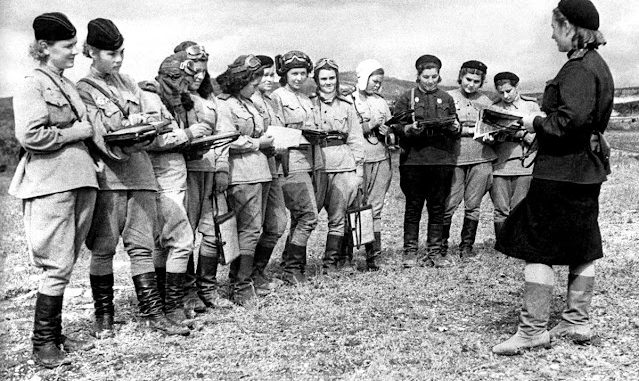
The “Night Witches” (German: Nachthexen; Russian: Nochnye Vedmy) were the all-female Soviet 588th Night Bomber Regiment (later the 46th “Taman” Guards Night Bomber Aviation Regiment) of the Soviet Air Forces during World War II. They flew harassment and tactical bombing missions on the Eastern Front from 1942 to 1945.
In October 1941, after the German invasion (Operation Barbarossa), celebrated Soviet aviator Marina Raskova (often called the “Soviet Amelia Earhart”) used her influence with Stalin to secure approval for three women’s aviation regiments. These were the 586th Fighter Aviation Regiment, the 587th Bomber Aviation Regiment, and the 588th Night Bomber Regiment. The 588th was the only one that remained entirely female throughout the war.
Most members were young volunteers in their late teens or early twenties, many with pre-war flying experience from civilian aviation clubs. The regiment was commanded by Major Yevdokiya Bershanskaya. Training was intense and compressed at the Engels Military Aviation School. The unit reached the front in mid-1942 as part of the 4th Air Army.
They flew obsolete Polikarpov Po-2 (also called U-2) biplanes—slow, open-cockpit wooden-and-canvas aircraft originally designed for training and crop-dusting. Fully loaded, they could carry only about 350 kg (770 lb) of bombs (typically two), had a top speed around 60–90 mph depending on load, and lacked radios, radar, or modern instruments in early use. Crews (pilot + navigator) often flew without parachutes until later in the war because of weight and low altitude.
Their signature tactic was to idle the engine near the target and glide in, releasing bombs with only the soft whooshing of the airframe (likened by Germans to a witch’s broomstick). This reduced detection by radar or sound. Planes operated in groups: some drew searchlights and flak while others approached silently. Crews typically flew 8–18 short sorties per night (each 30–50 minutes), returning to rearm and refuel. The planes’ low speed and high maneuverability made them hard for faster German fighters to engage effectively.
From June 1942 until the end of the war, the regiment flew roughly 23,000–24,000 combat sorties, logged nearly 29,000 flight hours, and dropped more than 3,000 tons of bombs plus tens of thousands of incendiary shells. They damaged or destroyed railways, bridges, fuel depots, warehouses, armored vehicles, and troop concentrations while also performing supply drops. They supported major operations including the Battle of the Caucasus, the Kuban/ Taman/ Novorossiysk fighting, the Crimean Offensive, operations in Belarus and Poland, and advances into East Prussia and toward Berlin.
In February 1943 the unit received the elite “Guards” designation and was later titled the 46th “Taman” Guards Night Bomber Aviation Regiment for its role in the Taman Peninsula battles. It earned the Order of the Red Banner and the Order of Suvorov.
About 32 members died during the war (combat, crashes, or other causes). Twenty-three received the Hero of the Soviet Union (the highest Soviet military honor), more than any other women’s unit. Notable high-sortie pilots included Irina Sebrova (over 1,000 sorties). Marina Raskova herself died in a non-combat crash in January 1943 while leading another regiment and received a state funeral.
The women faced outdated equipment, harsh weather, frostbite, sexual harassment and skepticism from some male personnel, and the constant risk of flak and night fighters. After the war the regiment was disbanded (October 1945). Many members returned to civilian life; postwar Soviet society largely pushed women back toward traditional roles, and the unit’s achievements received less public emphasis for a time. Their story later gained wider recognition through books, documentaries, and popular culture (including the Sabaton song “Night Witches”). They remain one of the best-known examples of women in direct combat roles in World War II and a striking case of effective use of limited resources through skill, endurance, and unconventional tactics.


Leave a Reply