
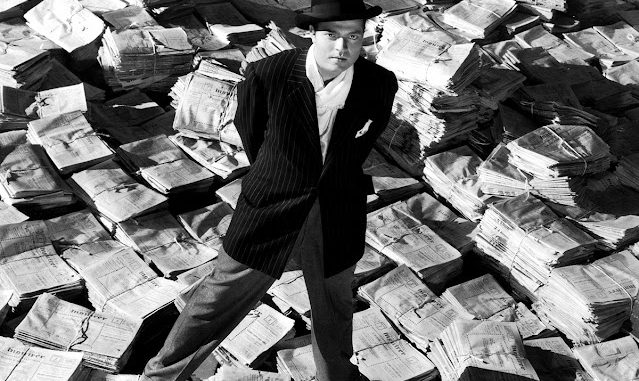
Production on Orson Welles’ masterpiece Citizen Kane (1941) was a hotbed of cinematic rebellion. Welles, a 25-year-old Hollywood outsider given absolute creative freedom by RKO Pictures, used his lack of filmmaking experience to his advantage by ignoring established rules and relying heavily on the technical brilliance of cinematographer Gregg Toland.
Before Citizen Kane, Hollywood sets rarely featured ceilings because they blocked the massive overhead studio lights. Welles wanted dramatic low angles to make Charles Foster Kane look imposing. To achieve this, the crew built enclosed sets with ceilings made of tightly stretched muslin cloth. The studio lights were rigged above the cloth to diffuse light down into the scene, allowing the camera to tilt upwards from the floor without exposing the empty studio rafters.
Welles and Toland wanted to place the camera even lower than standard tripods allowed. On several occasions, Welles ordered the carpentry crew to literally chop holes directly into the concrete or wooden studio floors so the heavy Mitchell camera could be dropped below ground level. This yielded the iconic low-angle perspectives seen during the political rally speech and the tense arguments in the newspaper office.
Toland experimented extensively with deep focus, a technique where everything in the frame, from objects mere inches from the lens to backgrounds dozens of feet away, remains perfectly sharp. On set, this required using newly invented coated lenses that reduced glare and allowed more light to enter; flooding the sets with immense, blinding amounts of light so they could close the lens aperture down tightly; utilizing in-camera optical composites, where one half of a scene would be filmed while the other half was masked in darkness, and then the film was rewound to shoot the second half in perfect focus.
Welles was a famously hands-on director, but during the filming of the dramatic staircase sequence, he fell and chipped his ankle. Refusing to let production stall, he spent two weeks navigating the RKO stages directing from a wheelchair, frequently using a massive megaphone to call out adjustments to the crew and cast across the echoing, cavernous sets.
Citizen Kane is frequently cited as the greatest film ever made. For 40 years, it stood at number one in the British Film Institute’s Sight and Sound decennial poll, and it topped the American Film Institute’s 100 Years … 100 Movies list in 1998, as well as its 2007 update. The Library of Congress selected Citizen Kane as an inductee of the 1989 inaugural group of 25 films for preservation in the United States National Film Registry for being “culturally, historically, or aesthetically significant.”
The film was nominated for Academy Awards in nine categories and it won for Best Writing (Original Screenplay) by Mankiewicz and Welles. Citizen Kane is praised for Gregg Toland’s cinematography, Robert Wise’s editing, Bernard Herrmann’s score and its narrative structure, all of which have been considered innovative and precedent-setting.


Leave a Reply