
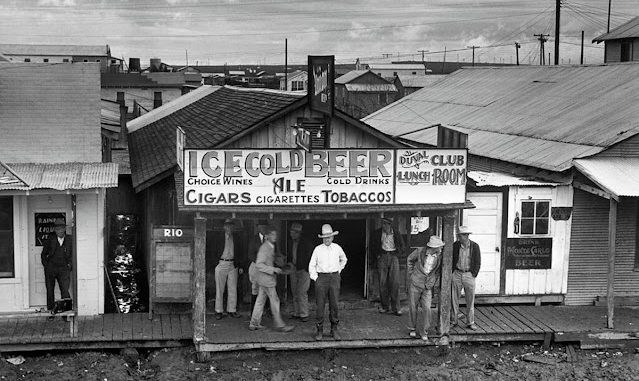
By 1938, the remote brush-country settlement of Freer, Texas, located deep in Duval County, had been violently transformed by one of the most classic, wild, and unregulated oil booms in American history.
What was just a lonely crossroads named Government Wells a decade prior became a sprawling, hyper-energized frontier oil town. The discovery of the Government Wells oil field in 1928, followed by the massive Loma Novia and Seven Sisters strikes in the mid-1930s, turned Freer into a roaring epicenter of black gold.
Freer’s main thoroughfares were notoriously unpaved for much of the boom. Depending on the weather, 1938 residents either choked on clouds of caliche dust kicked up by heavy oil-field trucks or watched model-T trucks and heavy drilling equipment sink axle-deep into treacherous South Texas mud.
The town was teeming with “boomers”—a nomadic army of roughnecks, wildcatters, pipeliners, lease hounds, and teamsters who traveled from field to field following the money (Johnson, n.d.). By 1938, the chaotic tent cities of the early 1930s were giving way to more permanent wooden structures, but the population remained intensely transient.
Situated in Duval County, a region dominated by the notorious South Texas political machine of Archie Parr and his son George Parr (the “Duke of Duval”), Freer operated under its own code of ethics. The town was packed with quickly built saloons, gambling dens, and dance halls to entertain weary roughnecks with cash burning holes in their pockets.
LIFE staff photographer Carl Mydans visited Freer in 1938 about found a town that was bustling but ramshackle, set up to suit the needs of roughneck mercenaries. His photographs captured a unique window into this rapid transformation, where modern industrial wealth clashed directly with rugged, lawless frontier living:


Leave a Reply