Before Dennis Hopper directed Easy Rider (1969) or became the chaotic icon of New Hollywood, he was blacklisted from major film studios. Following a legendary, combustible fallout with director Henry Hathaway on the set of From Hell to Texas (1958), Hopper found himself unable to get acting work.
To survive creatively, his then-wife, Brooke Hayward, bought him a 28mm Nikonis camera for his birthday. Throughout the 1960s, Hopper carried that camera everywhere, hanging it around his neck like a permanent fixture. He didn’t just document the decade; he lived at the exact epicenter of its most explosive cultural shifts.
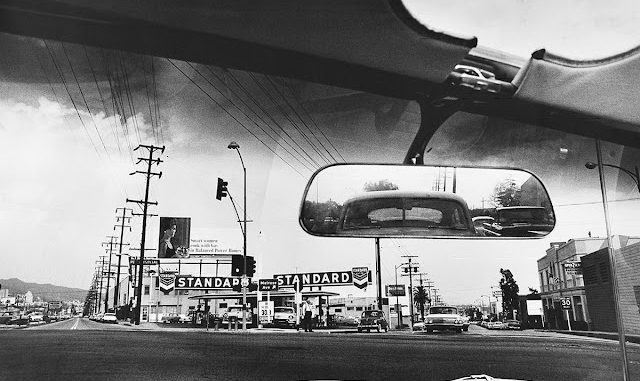
Hopper approached photography with a strict, gritty realism. Influenced by street photography pioneers like Henri Cartier-Bresson and Robert Frank, he established a rigid set of rules for his work. He refused to use a flash, relying entirely on ambient and available light, which gave his black-and-white images an intimate, high-contrast texture. He famously insisted on never cropping his photos in the darkroom. What he shot through the viewfinder was exactly what appeared on the final print, often leaving the raw, black film borders visible.
Hopper noted that carrying the camera allowed him to blend into volatile environments, whether a civil rights march or a Hells Angels gathering, because people simply dismissed him as a harmless tourist or a press photographer.
Hopper’s photography from 1961 to 1967 serves as a masterful, front-row time capsule of three distinct American subcultures. Because he was an actor, he had unprecedented, candid access to the stars of his generation. His portraits are distinctly devoid of typical studio-managed glamour, capturing his subjects in quiet, intensely human moments. He captured a shirtless Paul Newman resting on a set, an enigmatic Jane Fonda bicycling through a backlot, and striking, intimate frames of close friends like Tuesday Weld and Dean Stockwell.
Hopper was an early, obsessive collector of Pop Art before the movement exploded. He became an intimate fixture in the art scene, capturing defining portraits of Andy Warhol (whom Hopper famously threw a welcoming party for when Warhol first came to Los Angeles), Roy Lichtenstein, and Ed Ruscha. Concurrently, his camera tracked the rapidly shifting music landscape, shooting iconic imagery of The Byrds, Jefferson Airplane, Brian Jones, and a famously intense, close-up portrait of Tina Turner commissioned by producer Phil Spector.
Hopper’s work extended far beyond celebrity. He was deeply embedded in the political and countercultural movements of the era. At the urging of Marlon Brando, Hopper traveled south to document the 1965 Selma-to-Montgomery marches. His photos of Martin Luther King Jr. speaking and the ordinary citizens marching alongside him are powerful works of historical photojournalism. He spent months embedded with the Hells Angels, earning their trust to shoot raw, unvarnished glimpses into outlaw motorcycle culture.
“I was capturing a world that I knew was disappearing, a world that was changing completely. I wanted to leave a record of it.” – Dennis Hopper
By 1967, Hopper largely put down the still camera. The years he spent framing shots, working with stark natural light, and tracking the movements of bikers, artists, and activists essentially served as the ultimate pre-production phase for his directorial debut. When he made Easy Rider in 1968, he simply took the exact visual language, subcultures, and street-level realism he had mastered in his photographs and set them in motion.



Leave a Reply