
Born Robert Edwin Cornish on December 21, 1903, in California (often associated with San Francisco or Berkeley), Cornish showed exceptional intelligence from a young age. He graduated from high school at 15, earned honors from the University of California, Berkeley at 18, and received his doctorate (Ph.D. or medical-related degree) by age 22. He was licensed to practice medicine around age 21.
Early in his career, Cornish worked as a researcher at Berkeley, exploring topics like reading glasses, heavy water isolation, and other scientific projects. However, by around 1932, he became obsessed with the idea of resuscitating the dead. He believed that clinical death was not necessarily irreversible if circulation and oxygenation could be restored quickly enough before irreversible brain damage occurred. His work was partly inspired by contemporary experiments in Russia and elsewhere on resuscitation, but his approach was highly unorthodox.
The See-Saw (Teeterboard) Method
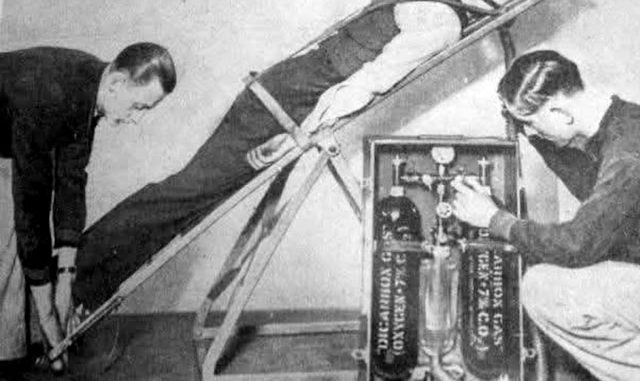
The cornerstone of Cornish’s technique was a large teeterboard or see-saw-like tilting table (sometimes called a teeter-totter). The idea was to use gravity and rhythmic rocking to artificially circulate blood in a body whose heart had stopped. The subject (human cadaver or animal) was strapped supine (on their back) to the pivoting board.
The board was rocked vigorously back and forth, alternating the head-up/feet-down and head-down/feet-up positions. This created a pendulum-like effect to move blood toward the brain and vital organs. At the same time, he injected a mixture into a vein (often in the thigh), typically including: epinephrine (adrenaline) to stimulate the heart; anticoagulants like heparin (or liver extract) to prevent blood clotting; oxygenated saline solution mixed with some blood or other stimulants.


Additional steps often included artificial respiration (e.g., breathing into the mouth) and manual rubbing of the body.
Cornish theorized that if intervention happened within minutes of clinical death (before full rigor or extensive brain damage), revival might be possible.
Leave a Reply