Erwin Blumenfeld (1897–1969) was a German-American photographer who fundamentally redefined the aesthetics of fashion and beauty during the mid-20th century.
Deeply rooted in the Dada and Surrealist movements, Blumenfeld treated the camera not merely as a recording device, but as a laboratory for avant-garde experimentation. During his legendary tenure at Vogue and Harper’s Bazaar, he introduced groundbreaking techniques such as solarization, multiple exposures, color filtration, and extreme cropping to create images that were both eerie and ethereal. His most famous work, the 1950 “Doe Eye” cover for Vogue, remains a masterpiece of minimalism, reducing the human face to its most essential, graphic elements.
Beyond the glamour of high fashion, Blumenfeld’s work was characterized by a lifelong obsession with the female form and a complex psychological depth born from his experiences surviving two World Wars. Today, he is remembered as a pioneer who bridged the gap between commercial photography and fine art, proving that a fashion image could be as intellectually challenging as a painting.
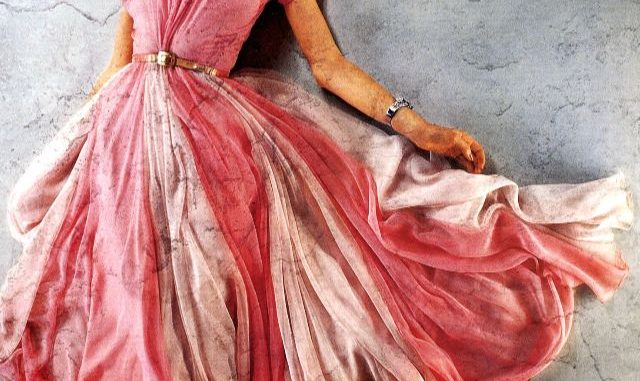
Mrs. Schuyler Watts in pink silk chiffon dress and make-up by Germaine Monteil, photo by Erwin Blumenfeld, Harper’s Bazaar, January 1942
Woman with camellias, photo by Erwin Blumenfeld, 1943
“Le Poudrier”, a study for an advertisement, photo by Erwin Blumenfeld, 1944
Goddess of New York, photo by by Erwin Blumenfeld, 1944
Model in raincoat, photo by Erwin Blumenfeld, 1944



Leave a Reply