Norway in the 1890s was a country on the brink of major transformation. Though still in a political union with Sweden (established in 1814), growing nationalist sentiment was building momentum toward full independence, which would be achieved in 1905.
The economy during this decade was shifting from rural and agricultural traditions to early industrialization. Hydropower development began laying the groundwork for future industrial growth, particularly in regions like Telemark. Fishing and maritime trade remained vital to coastal communities, while emigration to North America continued at high rates as Norwegians sought better opportunities abroad.
Culturally, the 1890s were rich with national romanticism. Artists, writers, and composers like Edvard Grieg and Knut Hamsun helped define a distinct Norwegian identity rooted in the landscape, folklore, and rural life. The expansion of railways and steamship routes also began to connect more remote parts of the country, changing how Norwegians lived, traveled, and interacted.
It was a decade of growing confidence, where tradition and modernity coexisted—and often collided—on the path to a fully independent Norway. Below is a collection of amazing Photochrom prints offering a glimpse of Norway in the 1890s.
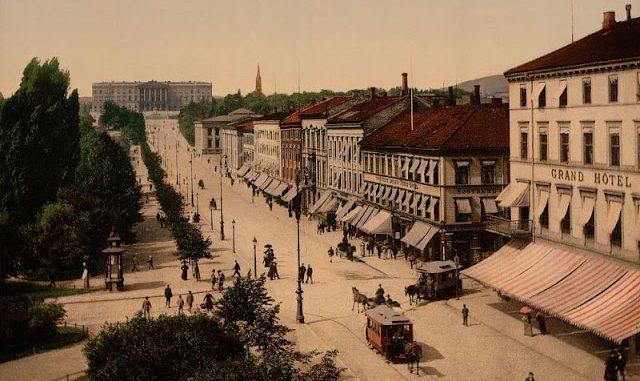
Karl Johans Gate with the Royal Palace, Christiania, Norway, circa 1890s
Fish market, Bergen, Norway, circa 1890s
A Lapp family, Norway, circa 1890s
Andrée’s Station at Danskøya, Spitsbergen, Norway, circa 1890s
Bondhus glacier and lake, Hardanger Fjord, Handanger, Norway, circa 1890s



Leave a Reply